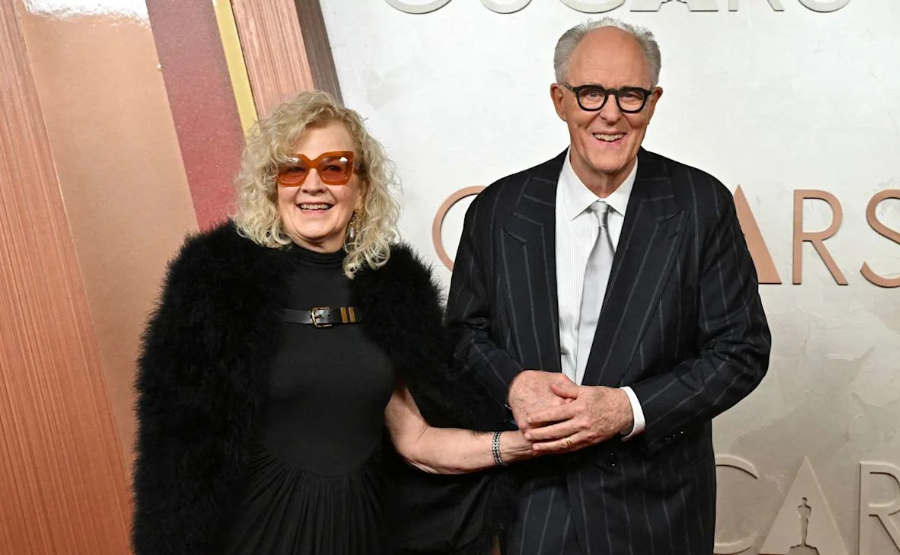
Jean Taynton Isn’t Who Google Is Telling You She Is — And That’s Part of What Makes Her Worth Writing About
Here’s something that will bother you once you notice it: Jean Taynton, the woman who financially supported John Lithgow’s acting ambitions through his early lean years, was six years older than him. She wasn’t a starstruck fan who married a famous man. She was the older one. The steadier one. The one with the job while he was auditioning. And yet every article that exists about her leads with what he went on to become.
That’s not unusual in the landscape of celebrity-adjacent women who get written about. It is, however, historically backwards.
Quick Bio
| Info | Detail |
| Full Name | Jean Phoebe Taynton (some sources; unverified) |
| Born | Approximately 1939, USA (6 years before John Lithgow) |
| Profession | English teacher |
| Marriage | John Arthur Lithgow, September 10, 1966 |
| Divorce | 1980 |
| Son | Ian David Lithgow (b. February 3, 1972, Cambridge, MA) |
| Cause of divorce | Lithgow’s affair with actress Liv Ullmann during 1977 Broadway production of Anna Christie |
| Post-divorce | Returned entirely to private life; no public statements, interviews, or social media |
| Visible after divorce? | Photographed with Lithgow in New York City, November 2010 — shopping together, cordially |
| AI misinformation | Falsely described online as a fashion designer, novelist, aviation pioneer, and “workplace resilience consultant” |
First, Let’s Deal With the Internet
Before anything else, you need to understand what has happened to Jean Taynton in search results. This matters. Because the volume of fabricated content about her is not just embarrassing — it’s actively deceptive.
Do a search. What you’ll find: articles calling her a “pioneering figure in aviation and space exploration.” A “British novelist born in 1972 known for literary fiction.” A “visionary workplace resilience consultant.” A “renowned figure in art and literature.” One site gives her a full fashion design career and a graduation from Central Saint Martins.
None of that is Jean Taynton. None of it is even close.
The real Jean Taynton was an American English teacher. She married a theater actor in 1966. She worked while he auditioned. She raised their son. The marriage ended in 1980 after her husband’s affair. She returned to her personal life. That’s the verifiable story.
The AI fabrication industry looked at the information vacuum around a private woman and filled it with generated nonsense. This is what happens when someone successfully stays out of public life in the internet age. The absence gets filled, and the fill is garbage.
Who She Actually Was Before the Marriage
Here’s what we know, stated plainly. Jean Taynton was approximately six years older than John Lithgow, who was born October 19, 1945. That puts her birth around 1939. She was American. She was an English teacher by profession. She met Lithgow during his college years — by some accounts they began dating around 1960, when he was 15 and she was approximately 21. Actually, wait — let me correct that. If the dating timeline from 1960 is accurate and she was 6 years older, she would have been around 21 and he around 15, which raises eyebrows. More likely they met a few years later, perhaps early in his Harvard years (he entered Harvard around 1963), and the “dating since 1960” figure is probably imprecise.
What is clearer: they had a theater connection. Multiple sources describe them being cast together in theatrical productions before they married. So this was not simply an actress-fan relationship or a star-and-spouse situation. They shared an interest in drama at the time of their meeting. She was older, more established, already teaching.
He was, by his own description, emotionally underprepared for marriage. John Irving, who blurbed Lithgow’s 2011 memoir Drama: An Actor’s Education, called it “the account of the young actor’s struggles with his too-young, too-early first marriage.” John Irving is not someone who throws away words carelessly.

The Work She Did That Went Unacknowledged for Years
Let’s be direct about the financial dynamic of this marriage. John Lithgow was a Harvard graduate who chose the theater. That meant years of auditioning, years of small parts, years of theater wages in New York City. During that period, the person who paid the bills was Jean Taynton.
She was the teacher. She had a steady salary. She was the reason they had somewhere to live while he built the career that would eventually bring him Emmy Awards, Oscar nominations, Tony Awards, and everything else that gets listed in his biography. The first version of “John Lithgow, actor” was funded by Jean Taynton, teacher.
One source from AmoMama, drawing on reporting around Lithgow’s memoir, explicitly notes that “Jean Taynton Sustained Their Family While John Lithgow Looked for a Job.” That’s not a romantic gloss — that’s the actual sequence of events.
The family relocated from New York to Branford, Connecticut at some point during this era. Ian was born in 1972 in Cambridge. Lithgow’s stage career was building through the early 1970s.
By 1972, the year Ian was born, Lithgow was doing his first Broadway work — The Changing Room earned him a Tony for Best Featured Actor. The career was taking off. The family had made it through the lean years. And the marriage would last eight more years before it didn’t.
The Night in Toronto That Ended Everything
The affair with Liv Ullmann is the chapter that everyone who has read Lithgow’s memoir remembers. But the specific detail that lands hardest — the one Lithgow himself recounts with something approaching devastation — is not the affair itself. It’s how Jean found out.
Lithgow was in Toronto on tour. The 1977 Broadway production of Anna Christie, where he played Mat Burke opposite Ullmann’s title character, had already brought them together. The chemistry on stage was “widely admired,” as one theater site puts it. The relationship had moved offstage.
Jean flew to Toronto to visit him. She brought their son Ian, who was about five or six years old at the time. She arrived not knowing anything. And then Lithgow confessed.
Think about that scene. A woman flies to another city with a small child to visit her husband. And she leaves knowing her marriage is over. The child presumably was there for some portion of this, in whatever way a small child is present for adult devastation that he can’t yet understand.
Lithgow called the infidelity the “neutron bomb” that ended his first marriage, in a New York magazine interview. The neutron bomb metaphor — the weapon that destroys people while leaving the building standing — is apt. The structure of the marriage had been holding. The person inside it was destroyed.
What John Irving Said, and What It Actually Means
John Irving’s blurb for Drama deserves more attention than it got. He wrote: “The portrait of his father is as finely articulated as it is heartfelt, and the account of the young actor’s struggles with his too-young, too-early first marriage is both moving and candid.”
“Too-young, too-early” is the operative phrase. This is not Lithgow’s description. This is Irving’s reading of Lithgow’s description. And Irving, who has written extensively and unflinchingly about marriages, desire, and consequence, is someone whose reading matters.
He’s saying: Lithgow wasn’t ready. The marriage happened before the person fully existed. And the implication — the uncomfortable one — is that Jean Taynton married a 20-year-old version of a man who didn’t yet know who he was, and paid the price when the actual man arrived.
Lithgow also described himself in the memoir as spending much of his early life cultivating a dutiful image, eager to please everyone. “God forbid that anyone should have known the real me,” he wrote. That person — the one maintaining a performance of correctness — was the one Jean married in 1966.
By 1977, 1978, 1979, the performance was cracking. And Jean was the one left holding the original contract.

The Son Who Became a Therapist
There’s something almost too structurally obvious about what Ian Lithgow did with his life, but that doesn’t make it any less true.
He attended Harvard — his father’s school — and then got an MA in Clinical Psychology from Antioch University Los Angeles. He runs a marriage and family therapy practice in Lower Manhattan. He also had an acting career, most notably as Leon in 3rd Rock from the Sun, where he played alongside his own father.
Ian Lithgow: Harvard graduate, actor, marriage and family therapist.
When he was eight years old, his parents got divorced. His mother was an English teacher who went back to private life. His father became one of the most recognizable character actors in America. Ian appears to have navigated that with enough stability to build two parallel careers — one on stage, one in a therapy office helping other people’s relationships survive things his parents’ didn’t.
You’d have to ask him whether he sees the irony. You could make a reasonable guess.
The 2010 Photograph That Nobody Talks About
Here’s the detail I keep coming back to, the one that reframes the whole narrative in a few seconds. Getty Images has a photograph. November 24, 2010. John Lithgow and Jean Taynton, photographed on the Upper West Side of Manhattan, 80th Street. Shopping together.
This is thirty years after their divorce.
Since 1981, he and Mary Yeager have been wed. That marriage has lasted over four decades. And yet in 2010, he and Jean were walking around the Upper West Side together on a Tuesday in November. Looking at the photo, there’s nothing dramatic in it — no visible tension, no awkward body language. Just two people who apparently still have enough of a relationship to spend a November afternoon together in the city.
This doesn’t tell us everything. It tells us that the picture of Jean Taynton as someone definitively left behind, closed off from all connection to her old life, is probably more complicated than the standard narrative suggests. She’s the mother of his eldest son. Ian is a Harvard graduate and a therapist in New York. Of course there are occasions and intersections.
But it’s also worth noting: she was willing to be photographed with him. In public. Thirty years later. That’s a choice.
What the Internet Is Doing to Her Memory
Let’s be unambiguous. The majority of content that now exists about Jean Taynton is fabricated. Articles call her a fashion designer, an aviation pioneer, a novelist, a business consultant. Some give her birth dates of 1975, 1985, different years entirely. One declares her “born in London, UK.” She’s American. She’s approximately 85 years old as of 2026 if she’s still living. She has no social media. She has given no interviews in living memory.
The absence of real information about a private person created a search vacuum, and AI content farms rushed to fill it. The result is a junk layer two inches thick sitting on top of the small but real story underneath.
Jean Taynton was a teacher. She was older than her husband. She supported him financially before he was famous. She raised their son after the marriage ended. She stayed completely private. Those are the actual facts.
Final Words
There’s a kind of person who disappears so completely from public life that the internet invents someone else to put in their place. Jean Taynton is that person.
She made a choice — maybe not consciously, maybe just by disposition — to have no public existence after 1980. No interviews. No memoir. No “my side of it.” No social media footprint. No public statements when John Lithgow became a household name, when he won Emmys, when he was profiled in every major magazine.
She just went back to her life. Which was, by all accounts, a teaching career and a son and a private existence in a city of millions.
The result is that the internet, which cannot tolerate a vacuum, manufactured at least five completely different Jean Tayntons to fill the gap. A novelist. A pilot. A fashion designer. A resilience expert. All of them fake.
The real one was a woman six years older than a young actor she believed in, who sustained him through the lean years, who flew to Toronto with their young son and came home knowing her marriage was over, and who apparently managed to be on cordial enough terms with him thirty years later that they could walk around the Upper West Side together without it being news.
That’s not the dramatic version. That’s just a life, and a complicated one.
You can decide whether the choice to stay completely private about it makes Jean Taynton admirable or simply unknowable. I’m going with admirable. She didn’t owe anyone her story. She kept it.
FAQs
1. Who is Jean Taynton?
Actor John Lithgow’s first wife is Jean Taynton, an American who used to teach English. They married on September 10, 1966, and divorced in 1980. Ian Lithgow, an actor and marriage and family therapist, is their son. She has maintained complete privacy since the divorce.
2. How old is Jean Taynton?
Born approximately 1939 — she was six years older than John Lithgow (born 1945). If she is still alive in 2026, that would put her age at about 86 or 87. Her precise birth date has never been publicly confirmed.
3. What led to the divorce of Jean Taynton and John Lithgow?
John Lithgow had an affair with Norwegian actress Liv Ullmann while they co-starred in a Broadway production of Eugene O’Neill’s Anna Christie in 1977. Lithgow later described this infidelity as the “neutron bomb” that ended his first marriage. He confessed to Jean when she flew with their young son Ian to Toronto to visit him while he was on tour.
4. Is Jean Taynton a novelist?
No. Multiple AI-generated websites claim she is a British novelist born in 1972. That person does not exist. Jean Taynton taught English in the United States. She was not British. She was not born in 1972. She wrote no novels. This is one of the most widespread pieces of misinformation about her.
5. Did Jean Taynton ever remarry?
Not publicly known. She has maintained complete privacy since the divorce in 1980 and has never confirmed or denied any subsequent relationship.
6. Who is Ian Lithgow?
Jean Taynton’s son with John Lithgow, born February 3, 1972. He attended Harvard University and earned an MA in Clinical Psychology from Antioch University Los Angeles. He is an actor known for his role as Leon in NBC’s 3rd Rock from the Sun (which also starred his father), and he runs a marriage and family therapy practice in Lower Manhattan.
7. Were Jean Taynton and John Lithgow on good terms after their divorce?
Apparently. A Getty Images photograph from November 24, 2010 — thirty years after the divorce — shows Jean Taynton and John Lithgow walking together on the Upper West Side of Manhattan, apparently shopping. They appear comfortable with each other. Neither has commented publicly on the nature of their post-divorce relationship.
8. What was Jean Taynton’s role in John Lithgow’s career?
Significant in the early years. During the period when Lithgow was establishing himself in New York theater, Jean — working as a teacher — was the financial foundation of their household. John Lithgow was building a career that brought in irregular income; Jean’s teaching salary provided stability.
9. Why is there so much false information about Jean Taynton online?
Because she maintains complete privacy and there is very little legitimate public information about her. AI content generation systems, which fill search voids with plausible-sounding text, have produced dozens of entirely fabricated biographies of “Jean Taynton” describing careers in aviation, fashion, literature, and business consulting. None of that is her.
10. Where is Jean Taynton now?
Unknown. She has maintained complete privacy for over four decades. No confirmed current location, no social media presence, no public interviews, no public statements of any kind have emerged since her divorce from Lithgow in 1980.
11. Was Jean Taynton mentioned in John Lithgow’s memoir?
Yes. His 2011 memoir, Drama: An Actor’s Education, covers his early life and career including his first marriage. He writes about Jean with candor and apparent regret, acknowledging that the marriage was “too-young, too-early” (John Irving’s characterization in his blurb) and that his infidelity destroyed it. He describes Jean physically — he was lanky, she was more solidly built, he used the terms “string bean” and “Brussels sprouts” — and he describes how she sustained the family financially during his struggling years.
Beyond the headlines, discover what’s worth knowing — TheTrendist.





One Comment