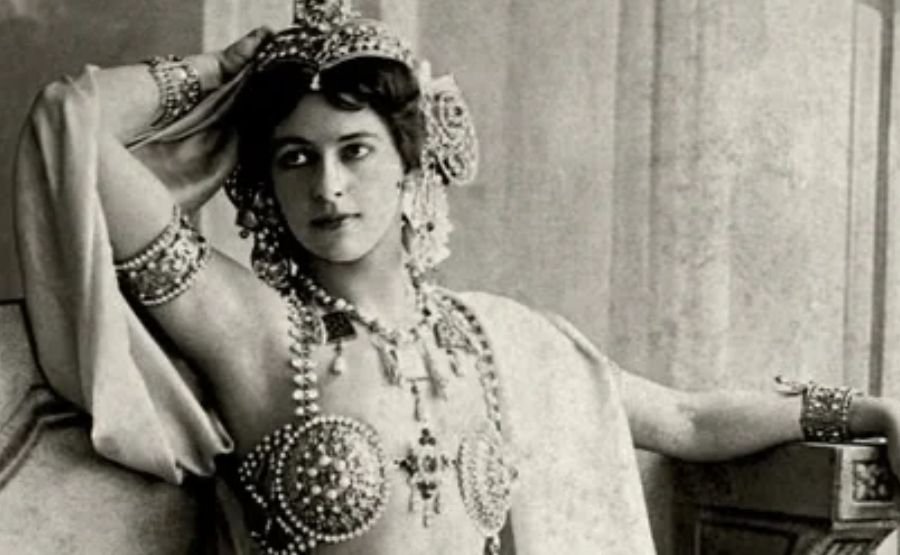
Mata Hari Was Not the Spy They Told You She Was — and France Knew It
The prosecution at her 1917 court-martial called her “the greatest woman spy of the century.” Here’s the thing nobody mentions: they made that up. No evidence supported it. No intelligence document substantiated it. The Germans — the side she supposedly betrayed the Allies for — had already written her off internally as an agent who delivered nothing of operational value.
France invented the most dangerous spy in the world and then shot her.
And then someone stole her head.
Quick Bio
| Detail | Info |
| Real name | Margaretha Geertruida Zelle |
| Born | August 7, 1876, Leeuwarden, Netherlands |
| Married | Rudolf MacLeod (1895), a Dutch colonial army captain 21 years her senior |
| Stage name origin | “Mata Hari” — Malay for “eye of the day” (sun); used this name in letters as early as 1897 |
| Paris debut | March 13, 1905, Musée Guimet |
| German agent code | H-21, recruited by Karl Kroemer, 1915 |
| French recruiter | Captain Georges Ladoux (later himself arrested for suspected espionage) |
| Arrested | February 13, 1917, Paris |
| Trial length | Two days (July 24-25, 1917); tribunal convicted in 45 minutes |
| Executed | October 15, 1917, Vincennes, France, by firing squad. Refused blindfold |
| Body | Unclaimed by family; given to medical science. Head embalmed, kept at Paris Museum of Anatomy, went missing — last seen 1954 |
The Morning They Shot Her
October 15, 1917. Early morning, before Paris woke up. Twelve French soldiers raised their rifles at a 41-year-old Dutch woman in a château at Vincennes.
Margaretha Zelle — the woman Paris knew as Mata Hari — had spent the night writing notes. One of them, scrawled on prison paper, said: “I am ready.” She refused a blindfold. She wasn’t tied. A British reporter named Henry Wales watched and wrote that she settled slowly to her knees when the volley hit, head still upright, face unchanged.
Nobody claimed the body.
The French gave it to medical students at the Sorbonne to practice surgery on. They embalmed her head separately and put it in the Museum of Anatomy in Paris as a specimen of — I’m not making this up — a “criminal type.” In 2000, when the museum was reorganized, archivists went looking for it. Gone. Her head had disappeared sometime around 1954. No record. No explanation.
The woman who once danced nude for Paris high society, who had performed at La Scala and the Folies Bergère, ended up as a missing anatomical exhibit.
That’s not the story most people tell.
See also “Eleanor Roosevelt Wasn’t a Saint. She Was Something Better Than That.“
A Dutch Girl Nobody Wanted
Let’s go back. Way back.
Leeuwarden, 1876. Friesland, up in the flat north of the Netherlands. Adam Zelle was a hat merchant who hit it big for a while, then lost everything. His daughter Margaretha — “M’greet” to the family — was the oldest of four and by most accounts the favorite. Spoiled, precociously confident, stubborn.
Her mother died when she was fifteen. The comfortable world dissolved. Her father remarried and sent the children away to various relatives. Margaretha got shipped to a teacher training school, which lasted until she was reportedly expelled for flirting with the headmaster. Make of that what you will.
At eighteen, she answered a newspaper advertisement placed by Rudolf MacLeod, a captain in the Dutch colonial army. He was 39. He’d been stationed in the Dutch East Indies (modern Indonesia) and wanted a wife.
Think about that for a second. A classified ad for a spouse. And she answered it.
They married in Amsterdam in July 1895. Within two years, MacLeod had brought her to Java. He gave her syphilis on the voyage over — the disease was rampant among colonial soldiers and there’s little dispute about the transmission. He drank. He was violent. He had other women constantly. He humiliated her in front of colleagues and friends.
But she loved Java. She threw herself into the local culture, learned Malay, watched traditional Indonesian dance, wore sarongs. She started calling herself Mata Hari in letters home as early as 1897. The name existed before the dance, before Paris, before any of the legends.
The Night Her Son Died
There are a few competing explanations for what happened on June 27, 1899, in Sumatra. The children — Norman, two years old, and little Louise Jeanne (called “Non”) — fell violently ill. MacLeod blamed a servant. Some historians believe the illness was a complication of syphilis treatment administered to both children. MacLeod himself had enemies on the base who were capable of poisoning a household meal.
Norman died. None survived.
Whatever actually happened that night, what followed is not in dispute. MacLeod blamed Margaretha for the death. He used the grief against her, used it as a weapon in a marriage that had always been a war. Then he beat her. Then he kidnapped Non and fled back to Europe.
She pursued. She got divorced. She fought for custody of her daughter. MacLeod was obligated by law to make child support payments. He never did. She couldn’t afford to keep fighting. She accepted it, believing — as she told people — that while he was a terrible husband, he had been a good father.
She left Non with him. She would spend years after trying to get her back, including — according to one account — bribing a maid to attempt a kidnapping that failed.
She never got her daughter back. Non died in 1919, two years after Margaretha.
What She Actually Invented in Paris
By 1903 Margaretha Zelle was broke and alone in Paris, performing as a circus horse rider under the name “Lady MacLeod.” She was sleeping with men for money. She needed a bigger angle.
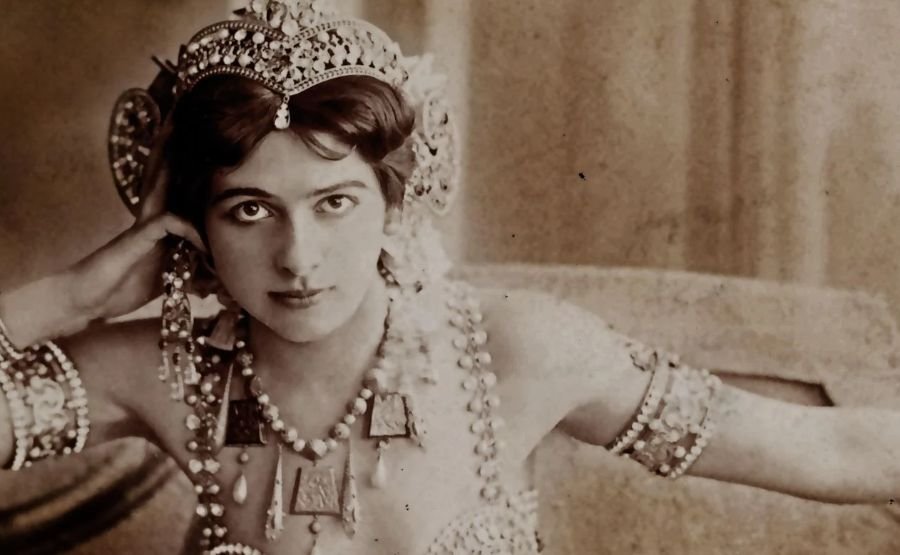
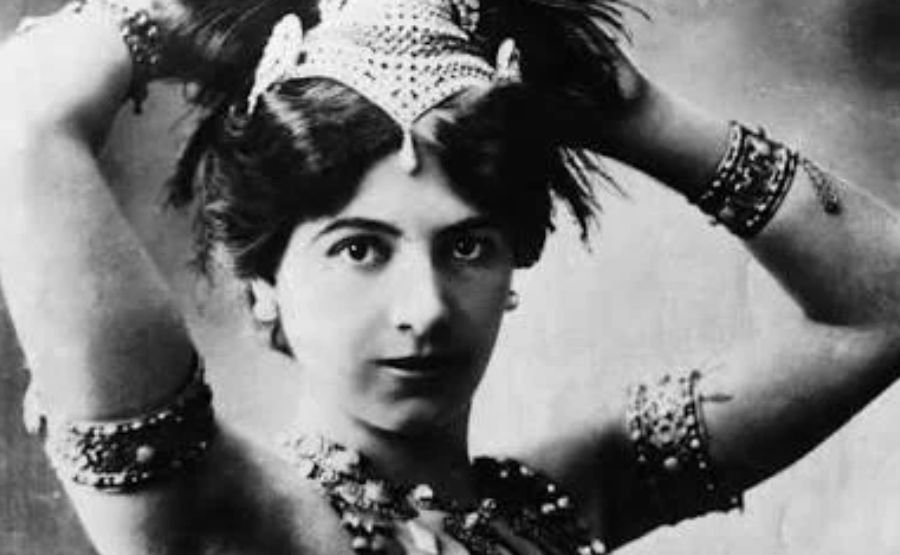
She found it through Émile Guimet, the millionaire founder of the Musée Guimet, an Oriental art museum. She convinced him she was a Javanese princess of Hindu priestly birth, trained since childhood in sacred Indian dance. She had props — gauzy shawls, a jeweled bra, ornate headpieces. The museum’s library was transformed into a Hindu temple for one night.
March 13, 1905. She danced. She stripped away the layers. The audience was select, wealthy, discreet. Within days, all of Paris was talking.
The backstory was completely fabricated. She was a Dutch woman from Leeuwarden who’d watched Indonesian folk dance during a painful colonial marriage. She had no formal dance training whatsoever. But she had something most trained dancers didn’t: the ability to build a room around herself just by walking into it.
Let’s be honest about what she was selling. It wasn’t actually a mystery or the East or ancient ritual. It was a body and a persona, and she was selling them to men who wanted to feel cultured while looking at a woman undress. She understood that transaction precisely and she monetized it ruthlessly. That’s not criticism — that’s recognition. She took what she had and made it work in one of the most competitive entertainment markets in the world, with no connections, no money, and no safety net.
The act was spectacular and it was also, underneath the stage dressing, a Dutchwoman improvising.
The Decline Nobody Talks About
Here’s the gap in most Mata Hari narratives. Her dancing career was essentially over by 1912. Maybe earlier.
Paris moved on. Orientalism as a fashion craze ran its course. The Russian ballets arrived and suddenly everyone wanted Diaghilev, not “sacred Indian dance” from a woman critics had begun to describe as a stripper with delusions of artistry. She tried to break into the Ballets Russes world. She didn’t have the technical training. She was rejected.
She was 36. Her most financially viable career was closed.
So she became a courtesan in the more traditional sense. High-end, yes. Connected to military officers and aristocrats, yes. But the romantic notion that she was cruising through prewar Europe at the peak of her powers as a great beauty and seductress doesn’t quite hold. She was an aging performer managing the transition from one kind of survival to another. Some of the men she slept with during the war years would later describe her as someone who talked too freely about her affairs and connections — not a sophisticated intelligence asset, but someone trying to seem important to people who valued that.
When World War I broke out in 1914, she was performing in Berlin. As a neutral Dutch citizen, she had the freedom to move across borders that combatants didn’t. That freedom would become the thing that killed her.
The Double Game She Didn’t Know She Was Playing
Late 1915. The honorary German consul in Amsterdam, Karl Kroemer, came up to her. He offered her 20,000 francs. She took it. Whether she fully understood what she was taking it for — and what she would be expected to do — is genuinely unclear. She accepted the designation H-21. She had no training. No contact protocols. No tradecraft whatsoever.
- She needed money. She needed permission to get to the front, where her young Russian officer lover, Captain Vadim Maslov, had been wounded. She went to French Captain Georges Ladoux, the head of French counterespionage, and proposed a deal. She would spy for France.
What she did next was breathtakingly naïve. She told Ladoux that she had already accepted money from the Germans. She thought this made her more useful — she could play both sides for the French. Ladoux, hearing this, now had everything he needed to either use or destroy her.
He chose the second option.
The plan Ladoux gave her: seduce Crown Prince Wilhelm of Germany. She traveled. She got nowhere close to the Crown Prince. In Madrid, she had an affair with Arnold Kalle, the German military attaché. She gave him gossip she claimed was already public knowledge. He sent a dispatch back to Berlin — in a code he knew the French had cracked — identifying H-21 as an extremely valuable agent.
Think about what that means. Kalle sent a deliberately decipherable message labeling her as important. Either he was burning her because he suspected she was working for the French, or he was a cynical participant in something that killed her regardless.
The French intercepted the message. Ladoux used it. The arrest followed on February 13, 1917.
Here’s what Ladoux never disclosed at trial: he had authorized her travel to Madrid. He had given her instructions. He was, by some accounts, her handler. None of that was entered as evidence. He let her face the court with no explanation of his own role in sending her there.
Ladoux was later arrested himself, in 1917-1918, on suspicion of espionage against France. Think about that for a moment.
The Trial That Lasted Two Days
The court-martial was closed to the public. Forty-five minutes of deliberation. Two days total.
The prosecution claimed she had caused the deaths of tens of thousands of Allied soldiers. They produced the intercepted German messages — but the only translations in existence were ones Ladoux had personally prepared. Original German-language versions were not presented. Her defense counsel was not allowed to call her as a witness in her own defense.
She admitted to accepting the German money. She denied having passed anything of military value. She insisted she was working for the French.
The all-male tribunal convicted her and sentenced her to death.
Here’s what the documents released in 2017 — sealed for a full century — actually showed when historians examined them: a prosecution built on thin, internally contradictory evidence. The Germans’ own assessment of H-21 before her arrest was that she produced little of operational value. Nothing she allegedly passed was demonstrated to have led to specific military outcomes. The claim that she caused mass casualties was pure theater, invented to make the verdict look proportionate.
France was losing soldiers by the hundred thousand in 1917. Mutinies were spreading through the army. Something had to explain the catastrophe, and Mata Hari was available.
What She Really Was
She was a woman who survived things that should have killed her earlier and found ways to keep surviving. The abusive marriage. The dead son. The colonial displacement. The invented identity. The precarious career that dried up. The aging while still having to rely on her body as currency.
She wasn’t a master spy. She wasn’t even a minor effective one. She took money she shouldn’t have taken from people she didn’t entirely understand, and then tried to spin the situation with the French in a way that only made sense if you had no idea how intelligence work actually functioned. Which she didn’t.
But she didn’t cause the deaths of tens of thousands of soldiers. The Germans said so themselves.
She was charged as the greatest spy of the century by the same government that couldn’t present a single piece of concrete evidence that she had actually spied to any meaningful effect. And the man who orchestrated her arrest — who alone held the translated “evidence” — was later under investigation himself.
Final Words
Here’s where I land on Mata Hari after years of reading about her.
She was guilty of something. She took German money knowing it was German money. She played a reckless game of trying to sell access she didn’t have to both sides of a world war while negotiating for permission to see her wounded Russian boyfriend. That’s not clever. That’s chaotic and desperate.
But the sentence they gave her was for crimes that didn’t happen. The evidence was likely manipulated. The man who built the case against her was later suspected of exactly what she was executed for. Her own government — the Netherlands — did essentially nothing. Her daughter was already dead. Her body went to anatomy students. Her head went missing.
The “greatest woman spy of the century” was, in fact, a middle-aged Dutch woman trying to survive in a world at war, who made bad decisions that she didn’t live to regret, while everyone around her — French intelligence, German intelligence, the court, the press — turned those bad decisions into something mythological.
You could argue the myth served her in one way: she’s still being written about. The women on all sides of WWI who did genuine intelligence work, who built real networks and took real risks for causes they believed in, are largely forgotten. Mata Hari got the films. Greta Garbo played her. So did Marlene Dietrich and Zsa Zsa Gabor.
Her true identity is not depicted in any of those movies. They’re about the legend France needed to construct to justify shooting her.
See also “Mallory Plotnik: The Untold Story of Phil Wickham’s Private Wife and the Truth Behind the Rumors“
FAQs
1. Was Mata Hari actually a spy?
She was H-21, a registered German intelligence contact who accepted 20,000 francs from Karl Kroemer in 1915. She also agreed to work for French Captain Georges Ladoux in 1916. Whether she passed anything militarily useful is genuinely disputed — the Germans themselves rated her as producing nothing of operational value, and French prosecutors couldn’t present concrete evidence of specific intelligence she transmitted.
2. Why did France execute her if the evidence was thin?
1917 was one of the worst years of the war for France. The army was mutinying. Casualties were catastrophic. A scapegoat who embodied moral corruption, foreign birth, and sexual transgression — all the things the conservative military establishment already hated — was exactly what the propaganda machine needed. She was convenient.
3. Did Mata Hari actually cause the deaths of thousands of soldiers?
No. The prosecution made this claim without providing any specific evidence tying her alleged intelligence to any specific military action or death. Germany’s own records indicated her work was minimal. The “tens of thousands dead” figure was a rhetorical invention.
4. What was her relationship with Captain Ladoux?
Complicated and suspicious. He recruited her, gave her a mission, and then used the intercepted messages about H-21 to arrest her — without disclosing his own role in sending her to Madrid in the first place. He was later himself investigated for suspected espionage. The full truth of what Ladoux knew and when has never been established.
5. Was she set up by the Germans?
Quite possibly. German attaché Arnold Kalle sent his dispatch identifying H-21 as valuable using a code he knew the French had already cracked. That’s either extremely careless or deliberate. If he suspected she was now working for France, burning her with a decodable message was a clean way to eliminate her without direct action.
6. What really happened to her son Norman?
He died June 27, 1899, in Sumatra. The most likely explanation, supported by biographer Pat Shipman, is that he died from complications of syphilis treatment — MacLeod had infected his wife, and the children were also affected. The “poisoned by an angry servant” story was the family’s public account, probably to avoid the stigma of syphilis. Either way, MacLeod’s behavior caused the death.
7. Who was Mata Hari’s last love?
Captain Vadim Maslov, a 23-year-old Russian officer. She was 40. She did all in her power to acquire permission to visit him after he was injured at the front, including going up to Ladoux. That visit request is what set the entire fatal chain of events in motion.
8. What happened to her daughter?
Louise Jeanne “Non” MacLeod was taken from her mother by Rudolf MacLeod during the divorce. Non died in 1919 — just two years after her mother’s execution. She was 21. The circumstances of her death aren’t always detailed in sources.
9. Was her dance actually any good?
Critics and contemporaries were divided, but many observed that her success owed more to her confidence, physical presence, and willingness to undress than to technical dance skill. She had no formal training. After Orientalism fell out of fashion around 1910-1912, she struggled to evolve her act and was rejected when she tried to enter the classical dance world.
10. What happened to her head?
No one claimed her remains, and the Paris medical faculty received her body for dissection after her execution. Her head was embalmed and kept at the Museum of Anatomy as what was labeled a “criminal type” specimen. In 2000, when the museum was reorganized, researchers went looking for it. It had vanished. Last confirmed sighting: around 1954. Current whereabouts unknown.
11. Could she have been cleared?
Based on what the 2017 declassified French archives showed, there was certainly enough doubt to prevent an execution. Her defense was hampered by procedural issues, the evidence was scant and conflicting, and the man who recruited and detained her was the only person who translated the important documents. In any modern legal system with basic due process, that case falls apart. But it wasn’t a modern system, and it wasn’t a civilian court — it was a French military tribunal in 1917, at the lowest point of the war, trying a foreign woman who had slept with the enemy.
Beyond the headlines, discover what’s worth knowing — TheTrendist.