
Aaisha Fletcher: The Woman Who Refused to Be a Footnote
The story most people tell about Aaisha Fletcher gets Muhammad Ali exactly right and gets Aaisha Fletcher completely wrong. She shows up in bios as a half-sentence. “Wanda Bolton, later known as Aaisha Ali.” “Mother of Khaliah.” Done. The camera pans back to Ali, the Greatest, the man with the story the world actually wanted to tell. And Aaisha — a teenager from a Philadelphia suburb who entered one of the most complicated romantic entanglements in American sports history — disappears into the footnote she was always supposed to stay in.
Quick Bio
| Detail | Information |
| Born as | Wanda Bolton |
| Birth date | May 29, 1956 (some sources vary) |
| Birthplace | Wayne, Delaware County, Pennsylvania |
| Mother | Dorothy C. Davies Wright |
| Known names | Wanda Bolton → Aaisha Ali → Aaisha Fletcher → Aaisha Gulshan |
| Connection to Ali | Islamic marriage ceremony, 1973 (not legally recognized) |
| Age when relationship began | ~16–17 |
| Daughter | Khaliah Ali (born Father’s Day, June 1974) |
| Relationship ended | ~1982 (when Khaliah was ~8 years old) |
| Legal action | Filed palimony/child support suit, January 1985 |
| Settlement | Muhammad Ali established $200,000 trust fund for Khaliah |
| Last confirmed public sighting | Photographed with Khaliah in Haverford, PA (Philadelphia Inquirer, 2009) |
A Sixteen-Year-Old and the World’s Most Famous Man
Let’s start with the fact that it makes everyone a little uncomfortable. Wanda Bolton was sixteen years old. Muhammad Ali was thirty-one. He was also — and this is not a minor detail — already married to Belinda Boyd, who had converted to Islam, changed her name to Khalilah, and was raising four of his children.
Think about that for a second. Not through the lens of mythology. Through the lens of arithmetic.
A girl barely old enough to drive. A man famous enough to have his face on every magazine in the world. His second wife at home. His third wife, Veronica Porché, is still a few years away. And somehow this — whatever this was — becomes the detail that biographers summarize in a clause.
Ali and Wanda married in an Islamic ceremony in 1973. The ceremony was real, the vows were real, the religious intent was real. The legal standing? Zero. American law doesn’t care about Islamic ceremonies conducted while one party is already in a civil marriage. Ali knew this. His advisors knew this. Whether Wanda, at sixteen, understood the full legal weight of what was happening — that’s one of the questions nobody has ever cleanly answered.
She’d go on to change her name to Aaisha. It’s what women who convert to or deeply embrace Islam often do. So she became Aaisha Ali, then later Aaisha Fletcher, and eventually Aaisha Gulshan. Four names in one lifetime. That alone tells you something about a person in constant self-revision, navigating something they didn’t quite have the right language for when it started.
See also “Jacqueline Bernice Mitchell: The Truth Behind the Internet’s Biggest Biography Mystery“
The Daughter Who Makes This Real
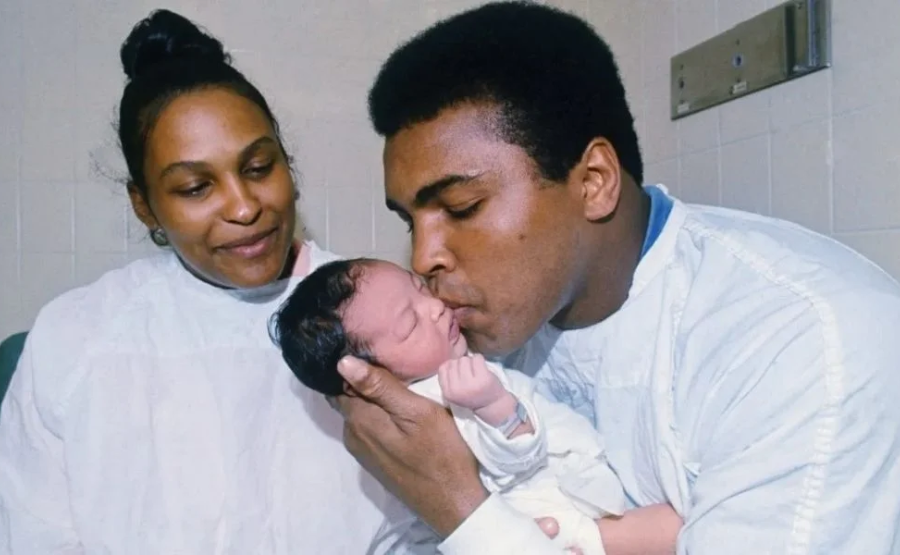
Khaliah Ali was born on Father’s Day, 1974.
Of all the details in this story, that one lands the hardest. Father’s Day. Ali was about to leave for Zaire — the Rumble in the Jungle, Foreman, the rope-a-dope, all of it. He apparently took one look at his newborn daughter and said, “Oh my God, she’s a Little Bird.” That became her nickname. That became her legacy, as she’d write years later in her memoir Fighting Weight.
For a moment, whatever this arrangement was, it held something tender in it. A nickname. A father’s voice. A Father’s Day birthday that Ali would have called fate.
And then life happened, the way life does in these situations.
Aaisha raised Khaliah largely on her own. Ali was married, then divorced, then married again to Veronica Porché in 1977. He was in Arizona. He was in training camps. He had nine children across multiple women and multiple decades. The attention was spread thin. Khaliah, in later interviews, was honest about the absence without being bitter about it. She said she loved the moments she had alone with him. She also said — and this is from a 2001 interview that keeps getting recycled without being examined — that she believed her father viewed her as a mistake.
Let that sit for a moment.
The father said “Little Bird” at birth. The daughter believed she was a mistake. Something happened between those two moments that nobody has fully documented. And the person who lived through that gap — the person raising Khaliah during the years Ali’s attention was elsewhere — was Aaisha Fletcher.
The Years Nobody Talks About
The relationship ended around 1982, when Khaliah was about eight years old. Sources are vague on the exact circumstances, because Aaisha herself has never spoken publicly about it in any interview anyone can find. What we have are genealogical records, court filings, and a few sentences in books about Ali.
For roughly three years after the split, apparently nothing was settled. Financially, legally, nothing.
Then, in January 1985, Aaisha Fletcher walked into court.
UPI reported it as a child support action. The Los Angeles Times called it a paternity suit. Some sources describe it as a palimony claim. The language varies depending on who’s telling it and what year they’re writing from, but the core is consistent: Aaisha said Ali was the father of her daughter and he had not been providing adequate support. She filed. Ali’s lawyers answered. The case settled when Ali agreed to establish a $200,000 trust fund for Khaliah.
Two hundred thousand dollars. For the daughter of the richest boxer on earth. That number has aged about as well as you’d expect.
But here’s what I actually want to point out: Aaisha Fletcher went to court. She didn’t disappear quietly. She didn’t accept a private payoff and vanished. She filed a formal legal action and made it a matter of public record. That’s not what someone who considers herself merely a footnote does. That’s someone who decided that her daughter’s rights mattered more than her own comfort, more than the optics of publicly confronting the Greatest of All Time.
Nobody gives her credit for that. I’m giving her credit for it now.
The Name Problem (Which Is Actually a Story Problem)
One of the genuinely strange things about researching Aaisha Fletcher is how many names she has and how casually sources swap between them without explaining the transitions.
She was born Wanda Bolton. At some point — probably around the time of or following the Islamic ceremony with Ali in 1973 — she adopted the name Aaisha and took his surname, becoming Aaisha Ali. This was common within the Nation of Islam and Muslim-American communities: a name change reflects a religious and personal transformation. It’s a meaningful act, not a paperwork quirk.
Then at some point she became Aaisha Fletcher. Where “Fletcher” comes from, public records don’t say. It suggests she either married someone named Fletcher or took a name in some other context. Some genealogical records also list her as Aaisha Gulshan. That’s an additional layer that most bios ignore entirely.
What this means is that tracking her across different historical documents is legitimately difficult. The 1985 court records used “Aaisha Ali.” Later news stories used “Aaisha Fletcher.” Genealogy sites use “Aaisha Fletcher Gulshan.” Same woman. Very different paper trail.
This is partly how someone disappears from the historical record even without trying. When your name changes multiple times across multiple decades, you stop being easy to search for. Scholars skip you. Biographers don’t bother. You become a name that gets typed differently in every article, and nobody connects the threads.
What Khalilah Knew (And the Part That Still Bothers Me)
Here’s the thing about Ali’s second wife that doesn’t make it into most of the clean, heroic narratives: Khalilah Ali — the legal wife, Belinda Boyd — knew about Aaisha.
Not just knew about her generally. Biographical sources on Khalilah mention that at some point she even booked hotel rooms so that Ali could spend time with his mistresses. She had, in some fashion, accepted the terms of a marriage to a man who operated by his own rules.
I’m not saying this to condemn Khalilah. What she navigated — a marriage at seventeen, to one of the most powerful and unfaithful men in the world, within a religious framework that gave him structural permission for certain arrangements — was its own impossible situation.
But I do want to point out what that means for Aaisha’s story. If the legal wife was in some sense aware of and accommodating the arrangement, then Aaisha Fletcher at sixteen wasn’t exactly a hidden secret. She was, in some murky way, part of a known configuration. That doesn’t make it less complicated. It might make it more.
What it also means is that Aaisha never had the protection of legal marriage or the sympathy of the wronged-other-woman narrative. She was something the culture didn’t quite have a category for. She wasn’t the wife. She wasn’t quite the mistress. She was the woman who had an Islamic marriage ceremony that the law didn’t recognize, with a man already in a legal marriage, and then raised their daughter largely alone for the rest of childhood.

The 2009 Photograph
The clearest public glimpse of Aaisha Fletcher as a living adult comes from a 2009 Philadelphia Inquirer story about Khaliah’s humanitarian trip to the Democratic Republic of Congo — the site of the Rumble in the Jungle, her father’s historic 1974 fight.
The photo shows Khaliah and her mother, Aaisha Fletcher, together in Haverford, Pennsylvania. Aaisha was 54 at the time. The article quotes her directly: she says she married the boxer in an Islamic ceremony in 1973, and that they broke up when Khaliah was about eight.
It’s a brief quote. Measured, factual, not dramatic. She doesn’t editorialize. She states what happened and lets it be what it was.
That’s consistent with everything we know about her post-Ali life: she has not given interviews, has no public social media presence, has made no effort to leverage her connection to one of the most famous humans of the twentieth century. She lives — or as of 2009 was living — in the Main Line suburbs of Philadelphia. She has a grandson named Jacob, Khaliah’s son.
For a person connected to Muhammad Ali, this level of invisibility is almost remarkable. Most people in that orbit found ways to stay in the frame. Aaisha stepped completely out of it.
Khaliah’s Life and What It Reflects
You can’t understand Aaisha without understanding who Khaliah became. Because Khaliah is, in many ways, the evidence of what her mother built.
Khaliah Ali graduated from Rosemont College and Cornell University. She became a fashion designer, a social activist, a television personality, a board member of Philadelphia’s Juvenile Law Center, and a published author. Her book Fighting Weight — about her decades-long battle with obesity, which peaked at 325 pounds after her son Jacob was born — was excerpted by ABC News and featured on the Today show.
She married Philadelphia attorney Spencer Wertheimer in 1998. She traveled to the Congo in 2009 to commemorate her father’s most famous fight. She was at Muhammad Ali’s bedside through his final days in June 2016. She said, in an interview before his funeral, that her earliest memories of her father were his hugs and kisses, and that he called her “Madame President.” She said he was “right there till the end.”
That reconciliation — imperfect, delayed, real — took decades to build. And it was built during years when Khaliah’s primary parent was Aaisha Fletcher, keeping things together on the Main Line while the rest of the world was focused on The Greatest.
I want to say something about the obesity piece, because I think it matters and because most bios about Khaliah treat it as a health story when it’s also clearly an emotional one. She wrote explicitly about the shame of being the heavy daughter of a man famous for his physical perfection. She appeared on the Today show at age nine, being publicly assessed for her weight. She spent thirty years yo-yoing. After her son was born she reached 350 pounds.
What was Aaisha doing during that? Watching. Present. The unnamed presence in the story. The one who doesn’t get the quote or the photo or the paragraph — but who was presumably in the room when her daughter was struggling.
The Contradictions That Don’t Get Resolved
A few things in this story don’t have clean answers, and I’d rather admit that than paper over it.
First: the precise year the relationship started. Some sources say 1973, some say 1974. Khaliah was born in June 1974, which means — if the relationship started in 1973 — Aaisha became pregnant at some point in late 1973 or very early 1974, at approximately sixteen or seventeen years old. If sources saying 1974 are correct, the pregnancy followed almost immediately from first contact. Neither version makes the age gap less significant.
Second: what the 1985 legal action was actually called. UPI said child support. The LA Times said paternity. Other sources say palimony. These are legally distinct things. I don’t have access to the original court filings, and no detailed account of the proceedings is publicly available. What we know for certain is that Aaisha acted, Ali settled, and $200,000 went into trust for Khaliah.
Third: what happened to Aaisha after 1985. Her trail genuinely goes cold in the public record until the 2009 Inquirer photo. Twenty-four years. That’s a long time to have lived a life with no documented public presence. It suggests she built something deliberately private, which is — given everything — completely understandable.
Final Words
I’m tired of the way this story gets told.
Ali’s biographers spend pages on his marriages, his infidelities, the women who came and went. Aaisha Fletcher gets a clause. And look — I understand why. The story the world wanted was his story. His fights, his faith, his politics, his wit. That’s the legend.
But Aaisha Fletcher was a teenager from suburban Philadelphia who entered a religious marriage with one of the most powerful men alive, bore his child on Father’s Day, raised that daughter largely alone for eight years, and then had the nerve to sue him when he didn’t step up financially. And then she went back to her life and built something quiet and entirely her own.
That’s not a footnote. That’s a whole person.
She’s not a victim in the way easy narratives want her to be. She’s also not the villain or the opportunist some corners of the internet have tried to paint her as. She’s someone who existed at the intersection of youth, faith, famous power, and the particular chaos of Muhammad Ali’s personal life — and she came out the other side raising a daughter who turned out thoughtful, capable, and genuinely good.
Khaliah said Ali was “right there till the end.” I believe that. I also believe the reason Khaliah was intact enough to be there at that ending — to have built a marriage, a career, a son, a life — has at least something to do with Aaisha Fletcher, raising her in Haverford while the world looked somewhere else.
That’s the story that doesn’t get told. I just told it.
FAQs
1. Who is Aaisha Fletcher?
She’s the woman born Wanda Bolton in Wayne, Pennsylvania in 1956 who entered an Islamic marriage ceremony with Muhammad Ali in 1973 and later had his daughter, Khaliah Ali. She’s known publicly almost exclusively through her connection to Ali — which is part of the problem this article tries to push against.
2. Were Aaisha Fletcher and Muhammad Ali legally married?
No. The ceremony was Islamic and meaningful within that religious context, but it had no legal standing because Ali was still legally married to Belinda Boyd (Khalilah) at the time. Courts do not recognize a second marriage while a legal first marriage is active.
3. How old was Aaisha when she got involved with Ali?
About sixteen. Ali was thirty-one. It happened in 1973. This is stated in multiple sourced accounts including the Muhammad Ali Wikipedia article, ancientfaces.com genealogical records, and TheSwinging60s historical site.
4. What is Aaisha Fletcher’s real name?
She was born Wanda Bolton. She later took the name Aaisha Ali after the Islamic ceremony. She’s also known as Aaisha Fletcher and Aaisha Gulshan. All four names appear in documented records.
5. Why did Aaisha Fletcher sue Muhammad Ali?
She filed a legal action in January 1985 for unpaid palimony or child support — sources use different terms — because Ali had not been financially supporting their daughter Khaliah as she felt he should. The case was settled with a $200,000 trust fund established for Khaliah.
6. What happened to Aaisha Fletcher after the lawsuit?
She went back to private life. The clearest documented post-1985 public appearance is a 2009 Philadelphia Inquirer photo of her with Khaliah in Haverford, Pennsylvania. She gave a brief quote to that reporter. That’s about as close to a public statement as she’s ever made.
7. Who is Khaliah Ali?
Aaisha and Ali’s daughter, born Father’s Day, June 1974. She became a fashion designer, author (Fighting Weight), social activist, and board member of Philadelphia’s Juvenile Law Center. She married attorney Spencer Wertheimer in 1998 and has a son named Jacob. She was present at Ali’s deathbed in 2016.
8. Did Khaliah Ali have a close relationship with Muhammad Ali?
It’s complicated. After the split from Aaisha around 1982, Khaliah wasn’t around her father much. She described a belief, circa 2001, that he saw her as a mistake. But by 2009 and through his final years she described their relationship as good and loving, and said he was “right there till the end.” Relationships that are complicated don’t resolve neatly.
9. Where does Aaisha Fletcher live now?
Based on the 2009 Inquirer piece, she was living in the Main Line area of Pennsylvania (Haverford/suburban Philadelphia) at that time. No confirmed information exists about her current whereabouts.
10. How is “Aaisha” spelled — one A or two?
You’ll see both “Aaisha” and “Aisha” in published records about her. The double-A version is used in most genealogical and later biographical sources. Earlier court records sometimes used “Aaisha Ali.” The name itself derives from the Arabic name for the Prophet Muhammad’s wife, usually transliterated as Aisha in English.
11. Is Aaisha Fletcher still alive?
No confirmed reports of her death exist as of this writing, and she would be 70 years old in 2026. She maintains such a private profile that confirming current status through public records is essentially impossible. Everything points to a living person who made a deliberate choice to live outside the public eye — which, all things considered, is a choice that deserves to be respected.
Beyond the headlines, discover what’s worth knowing — TheTrendist.



One Comment