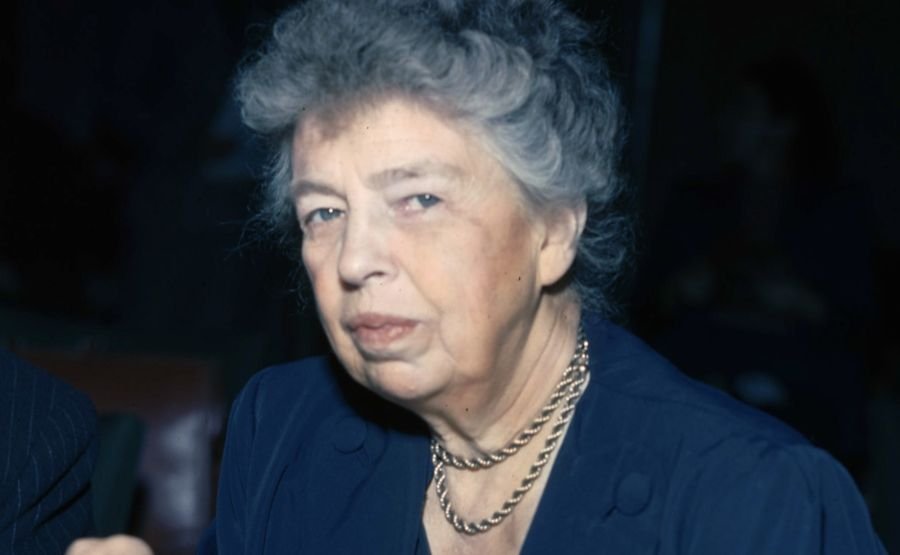
Eleanor Roosevelt Wasn’t a Saint. She Was Something Better Than That.
Here’s the story everyone accepts without questioning it. Eleanor Roosevelt was a woman wronged — the ugly-duckling wife, scorned by her mother-in-law, betrayed by her husband, trapped in a gilded cage called the White House. She channeled her suffering into compassion. She became the conscience of American liberalism. She died beloved. Case closed.
That story is not wrong. It’s just incomplete in ways that actually make her more interesting, not less. Because what Eleanor Roosevelt actually did — what makes her worth caring about in 2026 — is not that she suffered. It’s that she converted suffering into leverage with a precision that most trained politicians never achieve. By the time she was done, she had outmaneuvered her husband, outflanked J. Edgar Hoover, outlasted every person who called her a communist, and helped draft the most important human rights document of the 20th century.
She did all of this without ever holding an elected office. While her husband’s FBI spied on her. While she maintained what was, by all honest evidence, a thirty-year love affair with a woman. While the press mocked her looks, her voice, and her convictions.
She wasn’t a saint. She was more uncommon and more difficult to package.
Quick Bio
| Detail | Info |
| Born | October 11, 1884, Manhattan, New York |
| Full name | Anna Eleanor Roosevelt |
| Parents | Elliott Roosevelt (alcoholic, died 1894) and Anna Hall Roosevelt |
| Husband | Franklin D. Roosevelt (her fifth cousin, once removed) |
| Married | March 17, 1905 |
| Children | Anna, James, Elliott, Franklin Jr., John |
| First Lady | 1933–1945 (longest-serving) |
| Key relationship | Lorena Hickok — 30+ years, 3,300+ letters |
| Greatest stated achievement | Chairing the UN Commission on Human Rights; UDHR adopted December 10, 1948 |
| FBI file | 3,000+ pages; Hoover began surveillance in 1933 |
| Death | November 7, 1962 |
| Truman’s title for her | “First Lady of the World” |
The Night She Found the Letters
It’s 1918. Eleanor is sorting through Franklin’s luggage after he returns from a wartime trip to Europe. She finds a packet of love letters. They come from Lucy Mercer, the young lady Eleanor employed to serve as her personal social secretary.
Let’s sit with that for a second. Her own secretary.
Eleanor offered Franklin a divorce. She meant it. He reportedly wanted to take it — he was genuinely besotted with Lucy. What stopped him wasn’t virtue. It was a calculation. His mother Sara told him she’d cut off his money. His political handler Louis Howe told him a divorce would destroy his career forever. So Eleanor and Franklin negotiated a deal: no more sexual relations between them, no more contact with Lucy.
He agreed. He lied. He resumed contact with Lucy within a few years. He secretly arranged for her to attend his 1933 inauguration — while Eleanor stood smiling nearby. He had his daughter Anna help arrange meetings with Lucy in his final years, behind Eleanor’s back. When FDR died in Warm Springs, Georgia in April 1945, it was Lucy sitting with him in the room. Not Eleanor.
Eleanor only learned about the reunion after Franklin was already dead.
That’s not a love story. That’s a 27-year betrayal dressed in political convenience.
See also “Mallory Plotnik: The Untold Story of Phil Wickham’s Private Wife and the Truth Behind the Rumors“
What She Did With It
Here’s where the story gets genuinely astonishing. A less strategic person might have retreated. Instead, Eleanor took the 1918 confrontation and used it as a renegotiation. She walked away from that marriage with something FDR needed badly: her cooperation. And she extracted a price.
Think about it. She kept his political career alive, became his indispensable surrogate when polio paralyzed his legs in 1921, traveled to places he couldn’t go, spoke to audiences he couldn’t reach, and in exchange — she got to be Eleanor Roosevelt.
Not the conventional First Lady. Not the gracious hostess. The political actor.
She held 348 press conferences during FDR’s time as president — and she banned male reporters, which forced newsrooms to hire women to cover her. That’s not an accident. She had a syndicated newspaper column, “My Day,” running from 1935 to just weeks before her death in 1962. She joined a union. She testified before Congress. She had her own causes, her own network, her own public presence that sometimes made FDR visibly uncomfortable.
His advisers often described her as a problem. He rarely tried to rein her in. Because he knew, on some level, that he owed her.
The Childhood Nobody Fully Reckons With
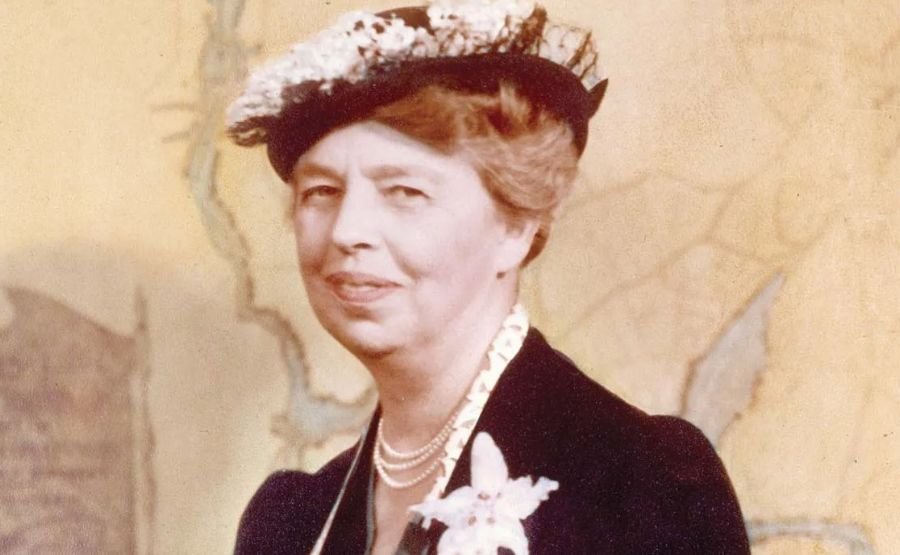
You’ve probably heard the basic outline. Eleanor’s mother Anna Hall Roosevelt was beautiful, cold, and called her daughter “Granny” as a nickname because of her serious, unsmiling face. Eleanor’s father Elliott — Theodore Roosevelt’s younger brother — was charming, warm, and an alcoholic who kept getting shipped off to sanitariums.
Eleanor adored her father. Worshipped him, really. He was the emotional center of her world in a family that otherwise treated her as an inconvenience.
Elliott Roosevelt died in 1894, when Eleanor was nine. He’d been confined to a sanitarium. He jumped from a window during a fit of delirium tremens. Before him, Eleanor had already lost her mother (diphtheria, 1892) and her younger brother Elliott Jr. (the same disease, 1893). Three deaths in three years. She went to live with her grandmother — described by one biographer as “rigid, conservative, unloving” — and her alcoholic uncles.
The family became concerned enough about those uncles that they sent her to England at fifteen.
Eleanor later wrote that she spent much of her early childhood feeling ugly, unloved, and starved for affection. “The ugly duckling” — that’s the phrase Joseph Lash used in his Pulitzer Prize-winning biography. Her own mother gave her that identity. The trauma of her father’s death compounded it. She suffered from depression throughout her adult life, something rarely gets enough attention when people talk about how “inspiring” she was.
She built everything she became from that foundation. Remember that.
Allenswood and the Woman Who Changed Everything
The grandmother’s plan worked, weirdly. At fifteen, Eleanor was shipped to Allenswood Academy, a boarding school in Wimbledon, London. The headmistress was Marie Souvestre.
Souvestre was a feminist educator who’d spent her career running schools that treated girls as actual thinkers. She lived openly with her female partner. She took a particular interest in Eleanor — traveling with her, discussing politics and literature, pushing her to form her own opinions instead of reflexively deferring to authority.
Eleanor later wrote: “For three years, I basked in her generous presence, and I think those three years did much to form my character.” She kept Souvestre’s portrait on her desk for the rest of her life.
She called those Allenswood years the happiest of her life.
There’s something quietly remarkable about this. The first person to really see Eleanor Roosevelt — to treat her as someone worth cultivating — was a progressive, feminist European woman who lived with a partner of the same sex. The parallels to Eleanor’s later relationship with Lorena Hickok are hard to ignore.
In 1902, her grandmother summoned her home to make her social debut. She was called back from the only place she’d ever felt fully alive, to play a role she never fully wanted.
Lorena Hickok and the Letters That Were Too Slow to Burn
In 1928, Eleanor met Lorena Hickok — an Associated Press reporter who was covering her husband’s political rise. “Hick.” They began a correspondence that would eventually fill eighteen boxes.
When archivists at the FDR Library opened those boxes in 1978 (per Hickok’s instructions, a decade after her own death), the contents caused a minor earthquake in Roosevelt scholarship. More than 3,300 letters over thirty years. Hickok writes about Eleanor’s eyes, the corner of her mouth, the feeling of her lips. Eleanor writes about being “empty without you.” Eleanor wore a sapphire ring that Hickok gave her on the night of FDR’s inauguration in 1933, while Franklin was getting sworn in across the room.
Eleanor installed Hickok in a White House bedroom just feet from her own.
The most explicit letters had been destroyed — burned, reportedly, because Hickok herself acknowledged that Eleanor “wasn’t always so discreet in her letters to me.” What survived is already what most historians call overwhelming evidence of at least passionate romantic love.
Here’s what bothers me about the way this story gets told. There’s a tendency to resolve it either with a confident “yes, they had a physical affair” or a defensive “we can’t prove anything.” Both moves are slightly evasive. The letters say what they say. These were two people who clearly loved each other with enormous intensity for thirty years. Whatever label fits, the experience was real and it mattered enormously to both of them.
What’s also worth noting: Hickok wasn’t Eleanor’s only close relationship. She had a sustained connection with her bodyguard Earl Miller. She had close, intense friendships with various women throughout her life. The pattern suggests someone who was deeply and consistently hungry for emotional intimacy — not surprising, given what you know about how she grew up.
What She Stayed Silent About
Let me be honest here, because the celebration of Eleanor Roosevelt sometimes slides past her genuine compromises.
Japanese internment. This is the big one.
On February 19, 1942, FDR signed Executive Order 9066, forcing more than 100,000 Japanese Americans into internment camps. Eleanor was caught completely off-guard. Weeks before Pearl Harbor, she’d publicly urged Americans not to turn against Japanese Americans. She’d reached out to the Justice Department beforehand about what might happen. She opposed it privately, fiercely.
But when her husband signed the order, Eleanor Roosevelt said almost nothing publicly against it.
She visited internment camps. She posed for photographs with Japanese American detainees. She gently advocated for their treatment behind the scenes. But outright public condemnation of her husband’s executive order? Largely absent.
After FDR died, she openly called internment a mistake and advocated for Japanese Americans’ return to their communities. But during the war itself, when did it mattered? Silence.
This is the gap between the icon and the person. The person understood that her power had limits — that she could push FDR on many things but not everything. That picking battles was necessary. That being First Lady, for all its advantages, also meant being constrained by what the President was willing to do.
Some historians think this was strategic pragmatism. Others think it was one of the genuine moral failures of her record. I don’t think those two things are mutually exclusive.
The Three Thousand Pages
J. Edgar Hoover started collecting material on Eleanor Roosevelt in 1933 — the moment FDR was elected. Her FBI file would eventually run to over 3,000 pages.
Hoover thought she was a communist sympathizer. Citizens wrote to him demanding she be stopped. Her syndicated column generated hate mail that went into the file. Her affiliations with labor unions, civil rights organizations, and progressive causes all got documented. When she traveled to the Soviet Union in 1957 and 1958, the FBI refused to release those surveillance records until a researcher had to sue under the Freedom of Information Act.
Eleanor’s response to Hoover was to call his FBI an “American Gestapo.” Publicly. While her husband was president and Hoover was technically working for FDR.
That’s not the behavior of someone afraid of powerful men.
There’s a strange irony in all of this. Eleanor was being surveilled by her own government for advocating civil rights, while simultaneously using her column and platform to push those same causes harder each year. She didn’t stop when she found out she was being watched. She kept going.
Her FBI file grew to 3,000 pages. The UDHR, the document she helped create, became law in 193 countries. History remembered exactly one of those two things correctly.
December 10, 1948, 3 A.M.
I keep returning to this moment.
It’s just past midnight in Paris. The General Assembly of the United Nations is in session. Eleanor Roosevelt, recently widowed, has spent two years navigating Cold War politics, Soviet obstruction, and diplomatic minefields to shepherd a document called the Universal Declaration of Human Rights toward a vote.
At 3 a.m. on December 10, 1948, the vote passed. Forty-eight nations in favor. Eight abstentions. Zero against.
The General Assembly gave Eleanor Roosevelt a standing ovation. At 3 a.m. In Paris. For a document she later called the greatest achievement of her life.
She was sixty-three years old. She had no formal legal training. When Truman appointed her to the US delegation to the United Nations in 1945, other delegates dismissed her as a “mushy, addled symbol” who would just absorb media attention and contribute nothing.
She outworked every one of them.
Today, international human rights law is based on the UDHR. Numerous countries have included it in their constitutions. When Truman called her “First Lady of the World,” it wasn’t flattery. It was the closest accurate description of what she’d actually done.
Final Words
The majority of individuals believe they know Eleanor Roosevelt. The inspirational-quotes version — the tea bag woman, the “you must do the thing you think you cannot do” woman — is real, but shallow.
The actual Eleanor Roosevelt was someone who watched her father die in a way that left marks for life, who suffered every possible betrayal a marriage can contain, who loved people in ways she couldn’t always name publicly, who compromised where she had to and fought where she could, who lived under surveillance by her own government, and who — in the last years of her life — was still writing “My Day,” still testifying before Congress, still refusing to be quiet.
She didn’t transcend her pain. She metabolized it. Over and over again, for seventy-eight years.
You can make her into a saint if you want. History keeps doing that. But what she actually was — a strategic, emotionally complex, sometimes contradictory woman who figured out how to use every disadvantage she was handed — is a far more useful story. Because saints are rare. People who learn to convert suffering into leverage while keeping their integrity mostly intact? That’s something the rest of us might actually be able to learn from.
She was better than an inspiration. She was a lesson.
FAQs
1. Was Eleanor Roosevelt really a lesbian?
The honest answer is: the evidence strongly points to her having had at least one sustained romantic love relationship with a woman (Lorena Hickok), likely more. But she never identified publicly with any label, the most explicit letters were destroyed, and whether the Hickok relationship was physically consummated is genuinely unknown and probably unknowable. What isn’t debatable is that the emotional bond was profound and lasted thirty years.
2. Why did Eleanor Roosevelt stay with FDR after discovering his affair?
The short answer: political calculation, financial reality, and her own growing ambition. Divorce in 1918 would have ended FDR’s career and left Eleanor with nowhere near the same platform she had as First Lady. What she lost in the marriage, she rebuilt as a political force. Was it the right call? Depends on what you value more.
3. Was Lucy Mercer actually with FDR when he died?
Yes. FDR died in Warm Springs, Georgia in April 1945. Lucy Mercer — by then Lucy Rutherfurd, having married a wealthy widower — was there. Eleanor was not. Eleanor also later learned that her own daughter Anna had been helping arrange FDR’s secret meetings with Lucy in his final years. That detail doesn’t appear in most of the warm biographical treatments.
4. What did Eleanor Roosevelt actually do at the United Nations?
She chaired the UN Commission on Human Rights from 1946 to 1948 and shepherded the Universal Declaration of Human Rights through two years of Cold War negotiations. She did this without formal legal training, facing open dismissal from male colleagues who thought she was a ceremonial figure. She considered it the greatest achievement of her life, and most historians agree with her.
5. Why did the FBI spy on Eleanor Roosevelt?
Because she was a civil rights advocate, labor movement supporter, and vocal progressive during a period when J. Edgar Hoover conflated all of that with communism. The file ran to over 3,000 pages. She responded by publicly calling his FBI an “American Gestapo.” He kept the file going anyway.
6. Was Eleanor Roosevelt a communist?
No. The FBI never found evidence to support formal action against her. What she was: a democratic progressive who subscribed to I.F. Stone’s newsletter, supported unions, and advocated aggressively for civil rights. In Hoover’s worldview, those things looked suspiciously similar to communism. They aren’t.
7. What was Eleanor Roosevelt’s relationship with Lorena Hickok?
At minimum: the most important emotional relationship of Eleanor’s adult life for a sustained period. The letters exchanged between them number over 3,300 across thirty years. Hickok lived in the White House. Eleanor wore Hickok’s ring the night of FDR’s inauguration. When Hickok died, Eleanor had been dead six years. Whether the relationship was physically intimate remains unresolved because the most candid letters were burned.
8. Why did Eleanor oppose the Equal Rights Amendment?
This surprises people. Eleanor Roosevelt opposed the ERA for years because she was worried it would eliminate protective labor legislation that had been hard-won for women workers — things like limits on working hours and physical labor requirements. She eventually came around on it later in life. It’s a good example of how her feminism was practical rather than ideological, and how even her most progressive positions had complicated backstories.
9. What happened with Eleanor and Japanese internment?
She privately opposed Executive Order 9066 and tried to intervene before it was signed. Once FDR signed it, she went largely quiet publicly — visiting camps, advocating behind the scenes, but not openly condemning her husband’s policy. After FDR’s death she called it a mistake. Many historians consider this one of the significant compromises of her record.
10. How did Eleanor Roosevelt transform the role of First Lady?
She held 348 press conferences — the first for any First Lady — and banned male reporters, forcing newsrooms to hire women. She wrote a syndicated column. She held a radio show. She took unpaid government positions. She traveled independently, held her own political positions, advocated for causes her husband wouldn’t publicly support, and generally behaved as a political actor rather than a hostess. Every subsequent First Lady has operated in the space she opened up.
11. What is Eleanor Roosevelt’s real legacy?
The UDHR is the clearest single answer — a document that forms the foundation of modern international human rights law. But the broader legacy is harder to quantify: the demonstration that a woman could operate at the highest levels of global diplomacy and political life without ever holding elected office. She invented a lane that didn’t exist when she started. And she did it while being wiretapped, mocked, betrayed, and widowed.
Beyond the headlines, discover what’s worth knowing — TheTrendist.