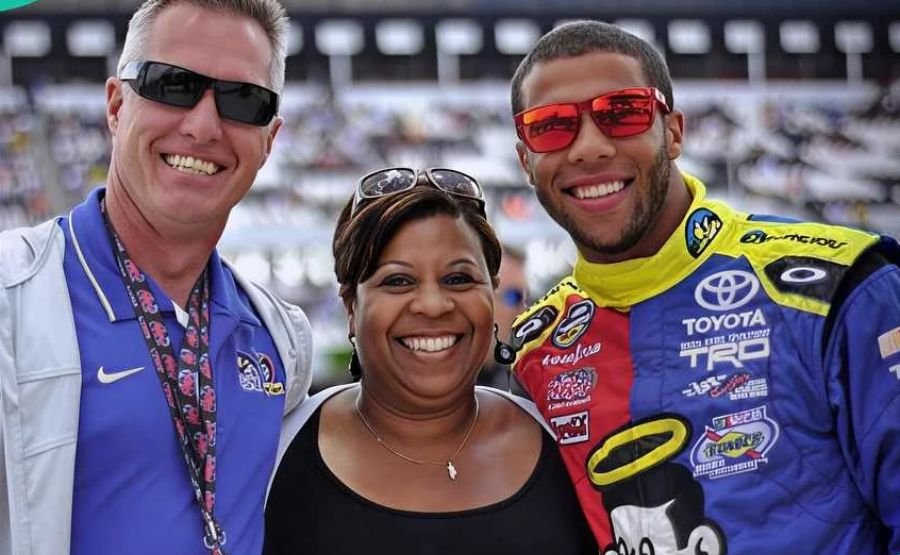
Bubba Wallace Parents: The Family Story Behind His Rise, Heartbreak, and NASCAR Journey
Let’s be honest about something most articles won’t say out loud: the “supportive NASCAR family” story the media loves to tell about Bubba Wallace is only half true. There was love there, genuinely. There was sacrifice and belief. But there was also a family that fractured, a father and son who came to blows, a kid who built his entire identity inside a car because the world outside it made no sense. The Wallace family story isn’t a feel-good Hallmark pitch. It’s more complicated than that, and frankly, more interesting.
Quick Bio
| Detail | Info |
| Father | Darrell Wallace Sr. — owner of an industrial cleaning company; born approx. 1969 in Alabama |
| Mother | Desiree Wallace — social worker; former track athlete at the University of Tennessee; now Desiree Lawrence after remarrying in 2021 |
| Racial background | Father is white; mother is Black — Bubba is biracial |
| Parents’ marriage | Married circa 1990; divorced 2016 after 20+ years |
| How racing started | Darrell Sr. bought a Harley-Davidson; the motorcycle shop owner raced go-karts; Bubba was nine years old |
| First sponsor | Darrell Sr. sponsored his son’s early go-kart and Bandolero career |
| Father-son rupture | Physical altercation sometime after parents’ divorce; Bubba confirmed it on Dale Jr.’s podcast in October 2019 |
| Key trauma | Bubba’s cousin Sean Gillispie, 19, shot and killed by a Knoxville police officer in 2003 — Bubba was nine |
| Reconciliation | Gradual, ongoing since ~2019-2022; Netflix docu-series reportedly accelerated the process |
A Motorcycle, a Mechanic, and a Kid Who Got Hooked
The whole thing started because Darrell Sr. wanted a Harley-Davidson.
Think about that for a second. One of the most consequential moments in modern NASCAR history — the path that led to the first full-time Black driver in the Cup Series in nearly 50 years — kicked off with a chrome motorcycle and a chance conversation at a bike shop in North Carolina.
Darrell Sr. took his newly purchased Harley to a local shop to get it cleaned up. The owner of that shop raced go-karts on weekends. He invited the Wallaces to come watch. Bubba was nine. He got hooked immediately. His father bought him a go-kart the same weekend and, as Bubba has told the story multiple times, they “never turned back.”
That detail matters more than people realize. It means the whole thing was an accident. Darrell Sr. didn’t set out to manufacture a NASCAR driver. He bought a motorcycle. Racing life chose the Wallace family as much as the Wallace family chose racing.
See also “The Woman Who Chose Quiet: Julie Brady and the Myth of the Famous Last Name“
Who Desiree Wallace Actually Is (Not Who the Articles Say She Is)
Every bio you’ll find online describes Desiree Wallace the same way: “social worker.” It’s technically true, and it’s also wildly insufficient.
This was a woman who ran track at the University of Tennessee. Competed athletically at a high level. Then built a career in social work — a profession that requires you to absorb other people’s worst days, repeatedly, without breaking. She wasn’t just a supportive mom in the grandstands. She had her own life, her own discipline, her own depth.
She was also the one who split herself in two so both her kids could chase their dreams at the same time. While Darrell Sr. was at racetracks every weekend with Bubba, Desiree was in gyms across the country following daughter Brittany’s basketball career. Different coasts, different sports, same level of commitment. You almost never see that detail mentioned. People focus on the father-son racing bond and forget there was a whole other sibling, a whole other sacrifice happening simultaneously.
Here’s the thing about Desiree that gets glossed over in the sentimental retellings: she was initially reluctant about Bubba’s NASCAR path. Not because she didn’t believe in him. Because she understood exactly what kind of world she’d be sending him into. She knew about the lack of diversity. She knew the danger — physical, social, emotional. A Black woman who’d lived in Alabama and Tennessee her whole life didn’t need anyone to explain to her what predominantly white spaces can feel like. Her hesitation wasn’t a weakness. It was wisdom.
She came around. Completely. But I think we lose something important when we skip past her initial doubt and jump straight to the proud-mom-at-the-track narrative.

The Part Nobody Wants to Linger On: A Cousin, a Cell Phone, a Police Officer
Bubba was nine years old when he heard his mother scream.
Not the kind of scream that means someone startled her. The other kind. He looked over and saw her running for the door. What she’d just found out: her nephew Sean Gillispie, 19 years old, had just been shot by a Knoxville police officer at a convenience store parking lot. A white store clerk had called the cops on a group of young Black people hanging around. An officer ordered Sean to put his hands up — Sean did. Then the officer walked away, and Sean reached for his cell phone to call his mom. That’s when the shot was fired.
Sean Gillispie died. The officer was cleared of wrongdoing. The family brought a wrongful death lawsuit; they lost it in 2006.
Desiree Wallace has said — on camera, in the ESPN E60 documentary — that she believes her nephew was found holding a bloody cell phone, not a gun. “Whenever a Black person is murdered by a white officer, it hits home,” she said. “We know what the families are going through.”
This is the event that shaped everything that came later. Bubba’s 2020 activism, his push to ban Confederate flags from NASCAR events, his raw emotional reactions that so many people found baffling or performative — it all flows from a kid who watched his mother dissolve in grief over a cousin killed for reaching for a phone. That’s not a media narrative. That’s a wound that never closed.
And Desiree was carrying it at every race she attended. Long before any of the cameras cared.
The Father Who Was Both Everything and Gone
Let’s talk about Darrell Sr., because the picture of him is genuinely contradictory — and the articles that try to smooth it out are doing everyone a disservice.
He was, by all accounts, an extraordinary early-career father. He turned a motorcycle hobby into a motorsport pipeline. He showed up every weekend. He was Bubba’s first financial sponsor when the kid needed money to keep racing. Bubba called him his best friend. That’s not press-conference stuff — that came out in a raw, unscripted podcast conversation years after things went sideways.
He also — and Bubba said this publicly, on Dale Earnhardt Jr.’s podcast in October 2019 — ended up in a physical altercation with his own son.
Here’s the timeline as best as it can be pieced together: the parents’ marriage of 20-plus years finally ended in 2016. The divorce was contentious enough that Bubba says he didn’t even know how bad things had gotten until his mother told him “your dad and I got into it.” Whatever she described was enough to make Bubba get in his truck and drive to his father’s place. “The light switch went off,” he said. “I got in my truck and went over and fought my dad, like swinging fists, just did before I thought. A physical altercation. For 15 years of racing it was me and him. And then that day, that was it.”
That’s a quote that deserves to just sit there for a moment without anyone editorializing over it.
Fifteen years of weekends at racetracks. First sponsorships. Best friends. And then one phone call from Mom, and fists.
What happened between those two in 2016 isn’t something Bubba has spelled out in public detail. He’s said the divorce itself was the fracture point. He said the estrangement “was a big chunk of the depression I’ve had.” Missing his father at the 2018 Daytona 500 — the race where he made history, came in second, and wept openly — he thanked his mom, his sister, his uncle. Not his father. That absence was loud.
The Complication of Being Biracial in a White Sport
This is where sources start to directly contradict each other, which is worth pointing out.
Some articles say Bubba’s father Darrell Sr. is white and his mother Desiree is Black. Others flip it — one EssentiallySports article states “his father is Caucasian and his mother is African-American,” while another article from the same site says the reverse. Multiple sites have gotten the racial identities of the parents backwards. The actual confirmed reporting — from NBC Sports, ESPN, Heavy, and Bubba’s own words — is clear: Desiree is Black and Darrell Sr. is white.
This matters because the family dynamic gets interesting when you think about it properly. Bubba has specifically said his white father encouraged him to represent the Black community and to be proud of that identity. A white business owner in Alabama pushed his mixed-race son to embrace his Blackness in a sport that had effectively erased Black drivers for half a century. That’s not a simple story. It’s a complicated one. And it apparently also involved contradictory advice: the ESPN documentary showed both parents giving Bubba different instructions about how to handle a traffic stop. Two different Americans lived under one roof.
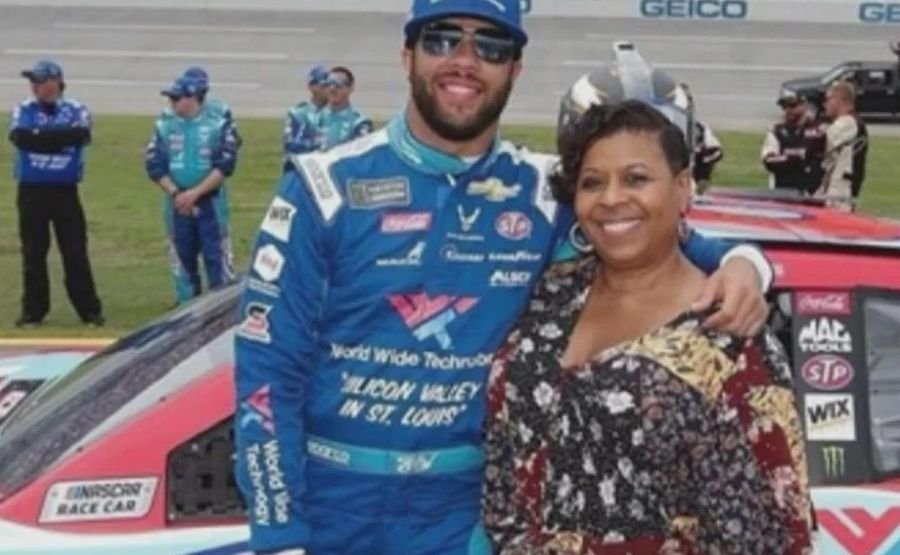
A Divorce That the Media Has Mostly Refused to Examine
The 2016 divorce between Darrell Sr. and Desiree happened in the middle of Bubba’s rise. He was 22 or 23. Already racing at a high level. Already trying to break through in a sport where he was constantly being reminded of his racial uniqueness.
And his family fell apart.
Bubba has said — and this is significant — that he kept quiet about the divorce publicly for years. “This is the first time I’ve talked about it,” he told Dale Jr. in 2019. “That’s why I like this show, because honesty comes out.”
The ESPN E60 documentary noted that all three of them — Bubba, Darrell Sr., and Desiree — refused to go into detail about what actually happened in the marriage or the divorce itself. That reticence is revealing. You don’t refuse to explain something on camera unless it still hurts, or unless it involves more than what you want the public to hold.
Critics of the ESPN documentary specifically pointed out this gap. The reviewer at lastcar.info wrote that the divorce “remains a subject so sensitive that all three won’t talk about it, shedding new light on Wallace’s battle with depression.” The doc hinted at it. But no one made anyone explain it.
What we do know: after the divorce, Desiree eventually remarried. She became Desiree Lawrence in July 2021. Darrell Sr. missed his son’s most historically significant race. And Bubba went through a period of depression serious enough that he broke down crying at a press conference in Kansas in 2019.
The Quiet Recovery Nobody Covered
The reconciliation between Bubba and his father has gotten almost no attention, which is telling in its own way. Conflict generates coverage. Repair apparently doesn’t.
It started slowly. Darrell Sr. began showing up at some races again. Bubba cautiously said in late 2019 that they’d “made some progress” but he wasn’t optimistic about a full return to how things were. By 2022, after the Netflix documentary “RACE: Bubba Wallace” aired — a series that apparently showed the father-son rupture honestly enough to jar both of them — Bubba said they were “starting to rekindle.” His words.
That’s a quiet thing. A father and son finding their way back toward each other, slowly, without a press conference or a neat reconciliation scene. The Netflix show gave them a shared mirror, and apparently that helped. That’s actually kind of beautiful, in a low-key way. Though I’ll note the obvious: the same media machinery that helped fracture the relationship’s public image also served as a tool for fixing it. There’s something worth sitting with there.
What Gets Missed When We Flatten This Story
The standard Bubba Wallace parents article hits the same beats. Dad introduced him to racing. Mom was supportive but nervous. Both are proud now. Isn’t that lovely.
What those articles miss: Desiree isn’t just proud. She’s a woman who watched her nephew die because he reached for a cell phone when he was scared. She’s a University of Tennessee track athlete who chose social work — not because it pays well, which it doesn’t — but because she believes in doing something that matters. She called into a radio show in 2020 during the Talladega noose incident and said her son was “an act of fear” target, and that other drivers had called him slurs, and that “we’ve been through all of that.” On a national radio program. Unscripted.
That’s not supportive-NASCAR-mom energy. That’s a woman with convictions who happens to have a famous son.
And Darrell Sr.? He’s a guy who built a business from scratch, turned a motorcycle purchase into an accidental legacy, gave his best years to a boy who would one day swing fists at him, and then — slowly, imperfectly — came back into that boy’s life. He wasn’t at the 2018 Daytona 500 when his son nearly won the biggest race in American motorsport. Think about what it cost him to watch that on TV.
These are real people with a complicated, painful, and genuinely fascinating family history. They deserve more than a table of bullet points.
Final Words
The narrative we’ve been sold — loving parents, supportive family, small-town Alabama roots leading to NASCAR glory — is true. It’s also insufficient. The Wallace family is held together by something tougher and stranger than that story allows for. A Harley-Davidson that accidentally launched a career. A divorce that almost ended a father-son bond. A dead cousin who explained everything about why a race car driver became an activist. A mother who ran track at Tennessee and shows up to radio programs to call out racism in real time.
Bubba Wallace didn’t come from a straightforward place. He came from two parents who were different in almost every way except their shared love for Dale Earnhardt Sr. and their belief that their kid was worth betting on. That the bet paid off in ways none of them could have predicted — and cost them things none of them talk about on camera — is the real story here.
Don’t let anyone reduce it to a table of fun facts.
FAQs
1. Who are Bubba Wallace’s parents?
His father is Darrell Wallace Sr., a white man from Alabama who owns an industrial cleaning business. His mother is Desiree Wallace (now Desiree Lawrence), a Black woman, former University of Tennessee track athlete, and career social worker. They were married from around 1990 until their divorce in 2016.
2. Is Bubba Wallace biracial?
Yes. His father is white and his mother is Black. Multiple sources online have this backwards — the confirmed, verified answer from Bubba’s own words and credible reporting is that Desiree is Black and Darrell Sr. is white.
3. Did Bubba Wallace’s parents support his NASCAR career?
Yes — but not without hesitation. Desiree was initially reluctant because she understood the dangers and the racial climate of the sport. Darrell Sr. was all-in from day one and even served as Bubba’s first racing sponsor.
4. Why did Bubba Wallace fight his father?
After his parents’ 2016 divorce, Bubba’s mother told him about something his father had done. Bubba drove to his father’s place and a physical fight occurred. He described it on Dale Earnhardt Jr.’s podcast in October 2019 as a fistfight that ended a 15-year closeness. Neither party has explained the specifics publicly.
5. What does Darrell Wallace Sr. do for work?
He owns and operates an industrial cleaning company. Some sources describe it as “Wallace Modern Inc.” He’s been an entrepreneur for years, and in Bubba’s early racing career, he functioned as his son’s title sponsor.
6. What is Desiree Wallace’s background?
She ran track at the University of Tennessee, graduated around 1987, and built a career in social work. She later remarried — becoming Desiree Lawrence in July 2021. She’s been vocal publicly about her son’s career and about racial justice, including during the 2020 Talladega noose incident.
7. Did Bubba Wallace’s parents attend his races?
His mother and sister were fixtures. His father — particularly after the 2016 divorce and the estrangement — was more sporadic. Notably, Darrell Sr. was absent from the 2018 Daytona 500, when Bubba finished second and gave an emotional post-race speech thanking everyone except his father.
8. What was the incident with Bubba’s cousin?
When Bubba was nine, his cousin Sean Gillispie — 19 years old — was shot and killed by a Knoxville police officer in 2003. The family says Sean was reaching for his cell phone to call his mother; the officer claimed he reached for a gun. The officer was cleared. The family lost a wrongful death lawsuit in 2006. This event profoundly shaped Bubba and Desiree’s views on race and policing.
9. How did Bubba Wallace’s father introduce him to racing?
Darrell Sr. bought a Harley-Davidson motorcycle in North Carolina. The mechanic at the shop where he took it raced go-karts on weekends and invited the family to watch. Bubba was nine. He was immediately obsessed. They bought a go-kart the same weekend.
10. Have Bubba and his father reconciled?
Partially. By 2019, Bubba said they’d made “some progress.” By 2022, after the Netflix documentary aired, he said they were “starting to rekindle.” The relationship is better than it was — not back to what it was before the divorce.
11. Why does Bubba Wallace’s family story matter beyond NASCAR?
Because it’s a story about race, geography, class, grief, mental health, and broken families — all compressed into the unusual container of professional motorsport. It matters because Desiree Wallace watched her nephew killed by police when Bubba was nine, and that moment echoed through every politically charged decision Bubba made in 2020. It matters because Darrell Sr. is a white man from Alabama who built a biracial son’s career in a predominantly white sport and then lost that son to circumstances the press still won’t examine closely. These aren’t just NASCAR facts. They’re American ones.
Beyond the headlines, discover what’s worth knowing — TheTrendist.

One Comment