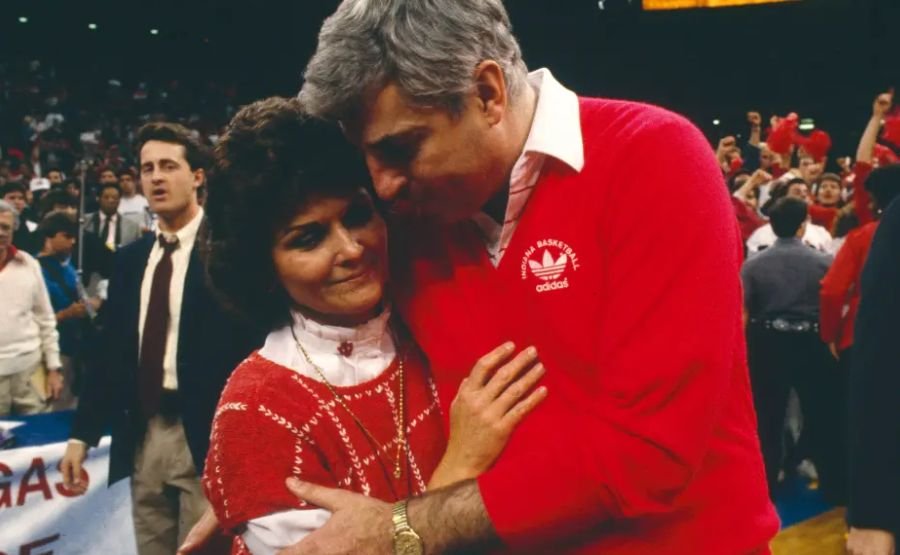
Karen Vieth Edgar: She Was A State Championship Coach Before Most People Had Heard Of Bob Knight — And That Part Never Trends
Here’s the thing nobody leads with: Karen Vieth Edgar was already a winning basketball coach when she married one of the most famous basketball coaches in American history. She’d spent fourteen years in Kingfisher County, Oklahoma, taking a tiny Class B high school to three state championships. She was already inducted — or on her way — into the Oklahoma Girls’ Basketball Hall of Fame. She had a record. A real one. And then she married Bob Knight, and for the next thirty-five years, roughly every sentence ever written about her began with the words “Bob Knight’s wife.”
That ordering bothers me more than it probably should.
She wasn’t some civilian who wandered into his orbit. She was a coach who understood the game, understood the demands of the job, and — as the public record shows on at least one significant occasion — understood the situation at Indiana better than the man coaching there did. She told him to leave six years before they fired him. He admitted it himself.
But we’ll get to that.
Quick Bio
| Detail | Info |
| Full Name | Karen Vieth Edgar (later Karen Vieth Knight) |
| Approximate Birth Year | ~1947 (was 41 at time of 1988 marriage) |
| Birthplace/Hometown | Kingfisher County, Oklahoma |
| Education | Bachelor of Science in Education |
| Coaching Career | Head girls’ basketball coach, Lomega High School, Oklahoma — 14 years |
| Championships | Three Oklahoma state championships at Lomega |
| Hall of Fame | Oklahoma Girls’ Basketball Hall of Fame; Oklahoma Sports Hall of Fame (2004) |
| Post-Coaching Career | Teacher and administrator, Bloomington High School North |
| Marriage | Married Bob Knight, May 23, 1988, Indiana Interchurch Center, Indianapolis |
| Knight’s Age at Marriage | 47 |
| Edgar’s Age at Marriage | 41 |
| Children Together | None (Knight had two sons, Tim and Pat, from first marriage) |
| Survived Bob Knight | Yes — he died November 1, 2023, Bloomington, Indiana |
| Media Interviews | None on record; consistently declined throughout marriage |
Before The Famous Last Name
Lomega is a small town in Kingfisher County, Oklahoma. The population is under a thousand. The high school has historically been one of the most dominant Class B girls’ basketball programs in the entire state — in the entire country, if you look at the volume of titles relative to the school’s size. When Karen Vieth took the head coaching job there, it wasn’t a media moment. It was a job. She was a young educator from that part of Oklahoma, she knew the game, and she went to work.
She coached the Lomega Lady Raiders for fourteen years. She won three state championships. The 1988 UPI wire story announcing her engagement to Knight described it exactly: “Edgar has been a successful coach, winning three Oklahoma basketball titles in 14 years at Lomega High School. Knight has won three NCAA championships in 17 years at Indiana.” That parallel framing wasn’t accidental. Even then, someone noticed the symmetry.
Think about that number. Three state titles in fourteen years at a school with maybe eighty kids in the whole district. You don’t accidentally do that. You recruit, you teach, you build a culture, you fight through the years when it doesn’t work, and you figure out what does. It requires the same obsessive attention to detail that Knight was famous for — and frankly feared for — at the Division I level.
She was later inducted into the Oklahoma Girls’ Basketball Hall of Fame. The Oklahoma Sports Hall of Fame in 2004 counted her among its inductees alongside former Blue Jay Joe Carter and others. That’s documented, publicly available, and almost never mentioned in anything written about her. The main thing written about her is “Bob Knight’s wife.”
I want to be precise about one thing before we move on. Some online sources claim she compiled a record of 222-18 with ten state titles, which would make her among the most successful coaches in Oklahoma history at any level. I can’t independently verify those specific numbers — the reliable sourcing, including the UPI wire from 1988, says three titles in fourteen years. The higher figures might be extrapolating from the entire Lomega program’s legacy (which has won seventeen total titles under multiple coaches), conflating her record with the school’s cumulative one. I’m sticking with three. It’s still remarkable.
See also “Not Chip’s Kid: What Nobody Actually Says About Drake Gaines“
How They Met, and What Nobody Will Tell You About It
Bob Knight declined to say. Karen Knight didn’t do interviews. Full stop.
What we know is that by June 1988, the Indiana Daily Student was reporting that Knight and “Karen Vieth Edgar,” described as “a high school basketball coach living in Kingfisher County, Okla.,” had filed for a marriage license in Monroe County, Indiana. They married on May 23, 1988, at the Indiana Interchurch Center in Indianapolis. He was forty-seven. She was forty-one.
The stories that have bubbled up online suggesting they met when she was an Indiana University student in 1975, or that they have two children together, or that she was a “former sportscaster and model” — all of this is invented. None of it has a primary source. The actual sourcing, going back to the original UPI wire, places her in Kingfisher County as a high school coach with no documented IU connection.
What we don’t know: how they met, how long they dated before the marriage, what the courtship looked like. Knight refused to discuss it. She refused to give interviews. Those refusals have been consistent across thirty-five years and multiple coaching stops. Make of that what you will — I read it as two genuinely private people who decided the marriage was theirs and the public didn’t need it.
In a career defined by explosions and press conferences and scenes, this particular relationship stayed quiet. That’s not nothing.
The Advice He Didn’t Take for Six Years
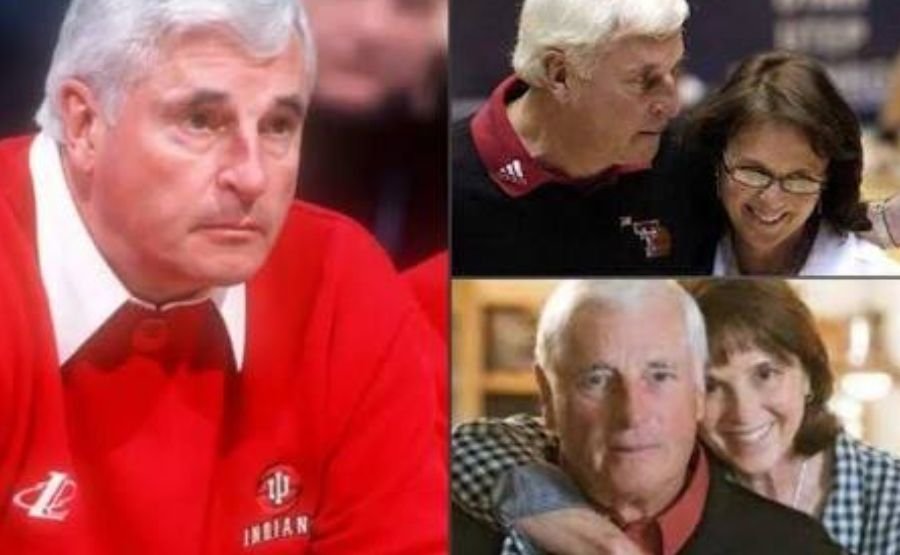
In early 2001, a few months after Indiana University president Myles Brand fired Bob Knight for a “pattern of unacceptable behavior,” Knight did a twelve-page interview. In it, he said something that should have been the lead of every Karen Vieth Edgar profile ever written.
He said he should have listened to his wife, Karen, who had advised him to leave Indiana six years ago.
Six years before 2000 is 1994. So roughly six or seven years before the student-grabbing incident that finally got him terminated — the event the whole world watched, the years of zero-tolerance policies and investigations and public chaos — Karen Vieth Edgar, the former Oklahoma high school coach who “brings sharp perspective from the stands,” had quietly told her husband: it’s time to go.
He didn’t listen. He stayed another six years, collected more championships, burned more bridges, created more incidents, and eventually got fired in a spectacle so large that six thousand people showed up to his farewell speech at Dunn Meadow. Then he admitted publicly that his wife had seen it coming a long time ago.
Let’s be honest about what that tells you. It tells you that Karen Vieth Edgar had been reading the IU situation clearly from the inside, that she understood institutional dynamics and Bob Knight’s relationship with authority, and that her judgment was right. It wasn’t right in hindsight as a lucky guess. It was right six years early.
Knight, characteristically, said this while also blasting the university officials. The paragraph where he acknowledges Karen’s wisdom is wedged between grievances. But it’s there.
Lubbock, and What She Said to Get Him There
When Texas Tech called in March 2001, Karen Vieth Edgar told her husband something that ended up in ESPN Magazine.
“Those people out there in Texas will have no trouble understanding you,” she said.
She was right about that, too. The Lubbock crowd showed up 7,500 strong for his introductory rally. The local culture embraced him. Texas Tech went from nine wins the previous year to twenty-three in his first season. The tournament appearances returned. The record-breaking win count continued. Knight himself would later say he was happy there in a way he hadn’t been at Indiana in years.
She’s from Oklahoma. She understood the West Texas mentality intuitively in a way a Connecticut-born Indiana coach couldn’t. That cultural translation — this is where you belong, this is where they’ll get you — was not a throwaway line. It was counsel that shaped where one of the most famous coaches in American history spent the last chapter of his career.
She also quietly worked as a tactical presence during the Texas Tech years. Knight described her to a reporter in 2005 as “a really good mind” who gave him “a different set of eyes” from the stands. Not that she was up there crocheting and attending social functions. She was watching practice, watching games, and feeding him perspective afterward. The Lawrence Journal-World ran a feature on this in 2005 when Tech went to the Sweet 16 for the first time in nearly a decade — and Karen Knight’s contribution to the program got a few paragraphs. Which is a few paragraphs more than she usually got.
She was an Oklahoma Girls’ Basketball Hall of Famer watching college basketball games with a coach’s eye. That’s what was sitting in those stands.
The Quiet Years at Bloomington North
Before she became “the wife of the Texas Tech coach,” there was a period after the wedding and before the Indiana firing when Karen was working as a teacher and administrator at Bloomington High School North. This gets one sentence in every biography of her and zero elaboration.
What does it mean? It means she made a choice. She’d been a head coach for fourteen years. She moved to Indiana to marry someone who was coaching at a different institution. She didn’t try to insert herself into the Indiana program. She found her own professional path — educator, administrator — at the high school level. She built a local identity separate from the basketball world that was eating her husband alive.
That’s either a deliberate choice to preserve her own professional independence, or a circumstance-driven adaptation to being married to someone whose professional life left no oxygen in the room, or both. I genuinely can’t tell you which. But it’s not the biography of a woman who dissolved into a supporting role. She was still employed, still contributing, still doing something of her own.
After Indiana, after Lubbock, after Texas Tech, she made two more moves without a public word: she and Bob moved from Lubbock back to Bloomington in 2019. By then his cognitive decline was already visible. This was a decision made, by all available evidence, by Karen. The reporting from Indiana media at the time says the move was motivated by the medical care available in Bloomington, and by Knight wanting to be in the place “where he is most revered and cherished.” She arranged it. She bought the house. She got him home.
The Years Nobody Covered
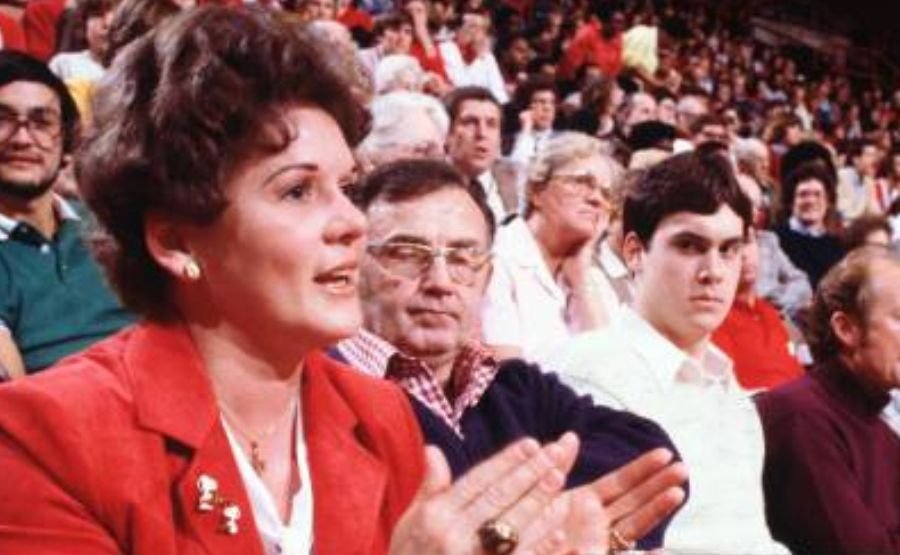
The public got the first visible hint of Bob Knight’s cognitive decline in April 2019, at a public event in Greenwood, Indiana. He re-introduced his wife Karen to the audience twice during the event, within minutes of each other. The Indianapolis Star reported that he seemed to forget he’d already done it. He also mistakenly said that former IU player Landon Turner had died — Turner was alive. He repeated stories.
The Indiana Daily Student, attempting to report on his return to Bloomington, reached out to Karen Knight directly. She declined to be interviewed. She was fielding media inquiries and managing her husband’s public image while his mind was quietly eroding, and she still didn’t talk to the press.
At some point during COVID — Pat Knight described it as “six, seven months in” — Karen called her son to say: your dad is “starting to forget who we are. Asking me, do I have a son?” She made that call. She initiated the conversation. She was the one managing the household reality of Bob Knight’s dementia while the outside world was still making plans for his return to Assembly Hall.
He did return to Assembly Hall in February 2020, one of the most emotionally charged events in Indiana basketball history. The crowd roared. Former players wept. Bob Knight, who had sworn he’d never go back, went back — and part of the credit for making that happen belongs to his wife and his old friends who convinced him to move home.
Six months later he could no longer reliably identify who she was.
She was his caregiver. For years. In a home in Bloomington, three miles from the arena where he’d won three national championships. She was there when he was hospitalized in April 2023 with pneumonia. She was there when doctors told the family he might not make it out. He did make it out. Then he died at home on November 1, 2023, “surrounded by his family,” in the words of the family statement.
She survived him.
The Misinformation Problem
Let me take a moment here to flag something important, because it genuinely matters if you’re trying to learn anything about this person.
The content-farm ecosystem around Karen Vieth Edgar is a swamp of invented biography. One site says she was born December 12, 1963 — making her forty-four years younger than she actually was and twenty-five years old when she married a forty-seven-year-old Bob Knight in 1988, which is mathematically absurd. The same site calls her “a former sportscaster and model.” Another invents “two children together.” Multiple sites claim she was an Indiana University basketball player who met Knight in 1975.
None of this is documented anywhere in real sourcing. The UPI wire from June 1988 — an actual contemporary news record — describes her as an Oklahoma high school coach. Full stop. Her alma mater is listed across reliable sources as a Bachelor of Science in Education, with no Indiana University connection. The “former IU player” narrative appears to be a content-farm fabrication, probably generated because it makes a tidier love story.
The actual story is not actually less interesting. A forty-one-year-old Oklahoma basketball coach with her own championship record and her own Hall of Fame credentials married a forty-seven-year-old Hall of Fame college coach. Two coaches. Same sport. Different levels, different genders, same corner of the world in which basketball is a religion. That’s the story. It doesn’t need embellishment.
Final Words
Karen Vieth Edgar gave consistent, clear-eyed counsel to one of the most combustible figures in American sports history — and he admitted it — and then she stood by him through the part that wasn’t on any highlights reel: the decline, the forgetting, the long years of caregiving that ended at home in Bloomington surrounded by family.
She never talked to the press. Not once, in any documented instance. She gave her perspective on his coaching — briefly, reluctantly — and that was it. Her quote declining to comment when he tied Dean Smith’s record was “absolutely” proud. One word and a deflection. She attended every game. She sat in the stands. She brought a trained coach’s mind to every game she watched, and she told him what she saw, and he credited her for it publicly, and that’s the most access the public ever got.
You can read that privacy as modesty, or as a form of protection for the marriage, or as a woman who made a clear-eyed decision that the spotlight following her husband was not hers to share, and chose to stay out of it completely. I lean toward the last one. She was a professional before he was famous. She had no particular need for his reflected glory. She didn’t give interviews before the marriage; she didn’t give them after. That’s not shyness. That’s preference.
What she leaves in the record is this: a three-championship coaching career in rural Oklahoma, a Hall of Fame induction, fifteen-plus years of contributing to Bob Knight’s last coaching chapter from the stands, and a final chapter of caregiving that she handled without complaint and without publicity, in a house three miles from an arena that will be telling Bob Knight stories long after anyone remembers her name.
She deserved more than a footnote. She got one anyway. Here’s the footnote, trying to say more.
FAQs
1. Who is Karen Vieth Edgar?
She’s the second wife of legendary basketball coach Bob Knight, whom she married in 1988. Before the marriage, she was a championship girls’ basketball coach in Oklahoma and a Hall of Famer in her own right. She survived Knight, who died November 1, 2023.
2. What is Karen Vieth Edgar’s coaching record?
She was head girls’ basketball coach at Lomega High School in Oklahoma for fourteen years and won three state championships. Contemporary sourcing from a 1988 UPI wire report confirms this. Some online sites claim larger numbers (ten championships, 222-18 record) but these appear to conflate her record with the school’s cumulative all-time record under multiple coaches.
3. Did Karen Vieth Edgar play college basketball at Indiana University?
There’s no primary source for this claim. It appears across several content-farm sites but is not in any contemporary reporting. A 1988 UPI wire report describes her simply as “a high school basketball coach living in Kingfisher County, Okla.” Her alma mater is listed in reliable sources as a Bachelor of Science in Education, but no specific institution is confirmed.
4. When and where did Karen Vieth Edgar marry Bob Knight?
May 23, 1988, at the Indiana Interchurch Center in Indianapolis. Knight was 47; she was approximately 41. They were married for 35 years until his death in 2023.
5. Did Karen Vieth Edgar and Bob Knight have children together?
No. Knight had two sons — Tim and Pat — from his first marriage to Nancy Falk. Karen had no biological children with Knight. Claims otherwise online are invented.
6. What is Karen Vieth Edgar’s Hall of Fame status?
She is a member of the Oklahoma Girls’ Basketball Hall of Fame. She was also among the inductees at the Oklahoma Sports Hall of Fame in 2004, alongside other notable Oklahoma sports figures.
7. Did Karen Vieth Edgar advise Bob Knight to leave Indiana?
Yes, and Knight said so himself. In a 2001 interview after his Indiana firing, Knight said he should have listened to his wife Karen, who had advised him to leave IU six years earlier — meaning around 1994. He acknowledged her judgment was right.
8. What role did Karen have in Bob Knight’s Texas Tech career?
Knight publicly credited her as providing a strategic coaching perspective from the stands — “a really good mind,” he said, with “a different set of eyes.” She was also the one who told him that West Texas culture would suit him, which helped convince him to take the Texas Tech job. She was a trusted informal advisor to the program, not just a spectator.
9. What happened to Karen Vieth Edgar after Bob Knight’s health declined?
She became his primary caregiver. She managed his dementia at home in Bloomington, the city they moved back to in 2019. She initiated communication with Pat Knight during COVID when Bob’s cognitive decline accelerated. She was present during his 2023 hospitalization and was with him when he died at home on November 1, 2023.
10. How old is Karen Vieth Edgar now?
She was approximately 41 when she married in 1988, which places her birth year around 1947. As of 2025, she would be in her late seventies. Her exact birthdate is not publicly documented in any verified source.
11. Did Karen Vieth Edgar ever give media interviews?
Almost never, by any documented account. Knight himself declined to discuss how they met. She made one brief public appearance after a Texas Tech win over Gonzaga in 2005 that was described by reporters as “rare.” She has consistently declined interview requests, including from the Indiana Daily Student in 2019 when they were reporting on Knight’s return to Bloomington.
Beyond the headlines, discover what’s worth knowing — TheTrendist.




One Comment