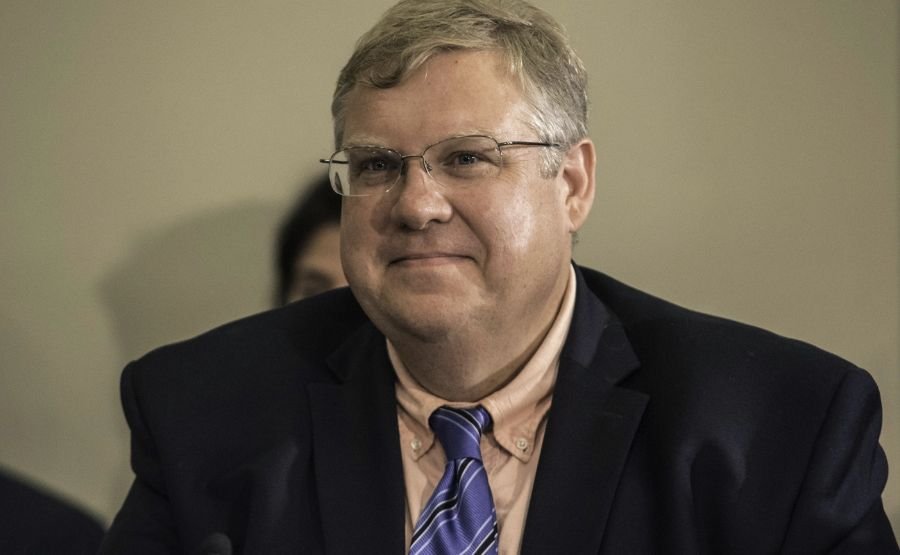
J. Christian Adams Has Spent 15 Years Warning About Voter Fraud That Nobody Can Find. That Tells You Something — But Maybe Not What You Think.
Here’s the thing about J. Christian Adams that neither side of the partisan aisle wants to admit fully. The man has been wrong about the specific evidence more times than anyone should be comfortable with — reports retracted, lawsuits against him, entire “alien invasion” voter rolls that turned out to include thousands of eligible American citizens. And yet the structural concerns about voter roll accuracy that he has spent his career litigating aren’t completely invented from nothing. This tension — between a crusader with a bad track record and a real underlying policy debate — is exactly what gets flattened every time his name comes up.
He gets called a fraud by the left and a hero by the right. Both are convenient. Neither is complete.
Quick Bio
| Detail | Info |
| Full name | John Christian Adams |
| Born | 1968, Hempfield, Pennsylvania |
| Education | West Virginia University (BA); University of South Carolina School of Law (JD) |
| Early career | Counsel to South Carolina Secretary of State Jim Miles, 1993–1997 |
| DOJ tenure | Voting Section attorney, 2005–2010 |
| Resigned | May/June 2010 — cited racial bias in New Black Panther Party case handling |
| DOJ internal review conclusion | Adams’ bias charges were without foundation |
| Organization founded | Public Interest Legal Foundation (PILF) — originally ActRight Legal Foundation, 2012 |
| PILF headquarters | Indianapolis, Indiana |
| Book | Injustice: Exposing the Racial Agenda of the Obama Justice Department (Regnery, 2011) |
| Trump appointments | Presidential Advisory Commission on Election Integrity (2017); US Commission on Civil Rights (2020, reappointed 2025) |
| Commission on Election Integrity result | Disbanded without finding evidence of significant fraud |
| PILF funding | Bradley Foundation: $340,000 in 2019 operations |
| Election lawsuits | 33 states and territory of Guam |
| Current term on Civil Rights Commission | Through December 2031 |
West Virginia to Washington: The Trajectory Nobody Traces
Before he was a Fox News fixture shouting about “alien invasions,” J. Christian Adams was a lawyer from Hempfield, Pennsylvania doing the slow institutional work of election administration.
He graduated from West Virginia University. Went to law school in South Carolina. From 1993 to 1997 he served as counsel for Jim Miles, the South Carolina Secretary of State — election administration work, the unglamorous inside-baseball kind. He filed an ethics complaint in Florida in 2001. He was reportedly involved in some Transportation Security Administration matters that made the San Francisco Chronicle in 2003. None of this made him famous.
He joined the DOJ’s Voting Section in 2005, under the Bush administration. That’s an important point. He was hired under Bush. He served under Bush. The very same DOJ culture he would later accuse of racism when Obama arrived — he was embedded in it for five years before the administration changed.
The Black Panthers Moment: What Actually Happened and What Got Amplified
On Election Day 2008, two members of the New Black Panther Party showed up outside a Philadelphia polling place. One had a nightstick. Fox News got footage. The Bush DOJ filed a civil complaint under the Voting Rights Act.
Then the Obama DOJ, reviewing the case, narrowed it — dropped charges against the party itself and one individual, pursued a reduced injunction against the guy with the nightstick. A career attorney named Christopher Coates, who headed the Voting Section, objected to this internally. Adams watched all this from inside the department.
Adams resigned in May 2010. Or June 4, 2010, depending on which source you’re reading — the American Prospect is pretty specific that he resigned specifically to be available for conservative media. On June 28, he published a Washington Times op-ed. He went on Fox News with Megyn Kelly, twice, in extended interviews. He testified before the US Commission on Civil Rights. He told Rush Limbaugh’s audience. He called the dropped case “the clearest case of voter intimidation I’ve seen since I’ve been practicing law.”
The DOJ’s internal review found his charges of racial bias to be without foundation. No voters filed complaints saying they were intimidated in Philadelphia that day. The Bush DOJ had similarly declined to pursue voter intimidation charges in a comparable case. Fox News, to its credit in one small moment, acknowledged that a source close to the case said Adams had “made willful misstatements.”
None of that information was as amplified as Adams’ original claims.

The “Alien Invasion” Reports: Where Things Went Actually Sideways
Here’s where you have to pay attention, because this is the episode that most thoroughly illustrates how Adams operates and why critics call him dangerous.
In 2016, PILF published “Alien Invasion in Virginia” — a report claiming to identify 5,556 voters as non-citizens who had fraudulently registered or voted. This wasn’t academic speculation. He submitted the reports to Trump’s election integrity commission as evidence. Stephen Miller, then a top Trump aide and the architect of the administration’s most aggressive immigration policies, emailed Adams specifically. Adams sent the “Alien Invasion” report right back.
A civil rights organization and four Virginia voters filed a federal lawsuit against Adams and PILF. Their allegation: thousands of the people identified in the “Alien Invasion” report were eligible American citizens whose registrations had briefly been flagged over citizenship questions — and then cleared. They had not voted illegally. But their names, now associated publicly with the phrase “alien invasion,” were in a document that had circulated through conservative media and ended up before Trump’s election commission.
Snopes — doing actual document forensics — obtained internal PILF emails and described the organization’s approach as working to “generate, create, organize and weaponize” misleading narratives. That’s a very specific characterization from their investigation. Whether you trust Snopes depends on your priors, but the underlying documentation they cited was real: the emails existed.
The Commission That Found Nothing, Then Dissolved
The Presidential Advisory Commission on Election Integrity was formed by Trump in 2017. Adams was appointed to it. He was, in many ways, its intellectual engine — this was the culmination of everything his career had been building toward since 2010. A presidential commission specifically chartered to find the fraud he had been claiming existed.
The commission requested voter roll data from all 50 states, including names, party affiliations, and other registration details. Most states refused to comply. Civil rights groups filed lawsuits. Privacy advocates reacted badly. Several of the 50 states said the data request was overbroad and potentially illegal.
The commission was disbanded less than a year after it was created without finding evidence of widespread voter fraud.
Adams described critics of the commission as “flat-earthers.” He said people who claimed there was no comprehensive proof of systemic voter fraud were equivalent to people who believe the earth is flat. It’s a striking rhetorical move — inverting the burden of proof so that skepticism of unproven claims is treated as the irrational position.
PILF: The Architecture of Perpetual Litigation
He founded the Public Interest Legal Foundation in 2012, initially as “ActRight Legal Foundation.” The name change is interesting — “ActRight” is more partisan; “Public Interest Legal Foundation” sounds neutral and institutional. The rebranding did its work.
The organization is based in Indianapolis. Funded significantly by the Bradley Foundation — $340,000 in 2019 for operations alone. Has connections to Judicial Watch and Heritage Foundation initiatives. Has litigated in 33 states and Guam.
PILF’s operational method, per the Snopes investigation and public records, is to use a provision of the 1993 National Voter Registration Act to demand access to voter rolls from state and county officials — sometimes under threat of lawsuit. Once they have the rolls, they analyze them for registrations that appear irregular. They then publish reports, flag names, generate media coverage in conservative outlets, and circulate the reports to political networks.
Think about that loop. The reports generate outrage. The outrage creates political will. The political will funds more litigation. The litigation gets more data. Repeat.
Whether this is good-faith election integrity work or a machine designed to cast doubt on democratic processes without finding actual fraud depends heavily on what standard of evidence you think applies. The courts have repeatedly declined to treat PILF’s claims as proof of widespread fraud. The states that have investigated the specific names PILF flagged have generally found the numbers dramatically overstated.
The Appointments That Keep Coming: 2020, 2025
Trump appointed Adams to the US Commission on Civil Rights in 2020. A man who built his national profile on claiming the Obama DOJ practiced racial discrimination against white victims, now seated on a commission historically dedicated to protecting civil rights for minority populations. The irony is substantial.
In November 2025, the White House announced his reappointment. He now serves through December 2031. He will be on the US Commission on Civil Rights for over a decade.
The Commission has had a Republican minority that has frequently written dissents against the majority’s findings on racial justice issues. Adams is among those who have been most aggressive in pushing back against what he sees as a politically captured civil rights apparatus. Whether that’s a reasonable critique of institutional bias or an attempt to undermine the commission’s historical mission is — let’s be honest — genuinely contested, and where you land on it probably tells you more about your politics than about Adams.
Final Words
Here’s where I actually land on J. Christian Adams after going through all of it.
He is a genuinely skilled political operator who identified a real gap — election administration in the United States is genuinely patchy, voter rolls in many jurisdictions genuinely do contain inaccuracies — and built a career on weaponizing that gap beyond what the evidence supported. The specific claims he’s made have repeatedly been found to be overstated, methodologically dubious, or outright wrong. The Black Panther case DOJ internal review cleared the department he accused. The “alien invasion” reports named thousands of legitimate voters as suspected fraudsters. The Trump election integrity commission he was attached to disbanded without finding what he promised it would find.
But he keeps getting appointments. He keeps getting funded. He has a term through 2031 on a federal commission.
The lesson isn’t that he’s uniquely dangerous — it’s that in American political life, being wrong about the specifics while being useful for the broader cause is a sustainable career strategy. Adams has executed that strategy with remarkable consistency for fifteen years.
Whether that makes him cynical or committed is something I genuinely can’t resolve. He may believe everything he says. The two things aren’t mutually exclusive.
FAQs
1. Who is J. Christian Adams?
He is a conservative attorney and activist, born in 1968 in Hempfield, Pennsylvania. He served in the DOJ’s Voting Section from 2005 to 2010, resigned over the Obama DOJ’s handling of the New Black Panther Party voter intimidation case, and has since founded and led the Public Interest Legal Foundation (PILF), which advocates for stricter voter ID laws and voter roll purges.
2. What is the Public Interest Legal Foundation?
PILF is a conservative nonprofit law firm Adams founded in 2012 — originally as “ActRight Legal Foundation.” Based in Indianapolis, it uses provisions of the National Voter Registration Act to demand voter roll data from states, then publishes analyses claiming to identify illegal registrations or votes. It has been litigated in 33 states and Guam.
3. What happened with the New Black Panther Party case?
In 2008, two New Black Panther Party members stood outside a Philadelphia polling place on Election Day; one had a nightstick. The Bush DOJ filed voter intimidation charges. The Obama DOJ narrowed the case. Adams resigned in 2010 accusing the DOJ of racial bias. A DOJ internal review found his charges to be without foundation.
4. Did J. Christian Adams ever found widespread voter fraud?
Not in any verifiable sense. His “Alien Invasion” reports in 2016 identified thousands of people as suspected illegal voters, many of whom turned out to be eligible American citizens. The Trump election integrity commission he served on was disbanded without finding evidence of significant fraud.
5. What is the “Alien Invasion” report?
A 2016 PILF report claimed 5,556 Virginia voters were non-citizens who had fraudulently registered or voted. A federal lawsuit was filed against Adams and PILF alleging the report falsely identified thousands of eligible citizens. Adams submitted the report to Trump’s election integrity commission and shared it with Stephen Miller.
6. What did Trump appoint J. Christian Adams to?
Two things: the Presidential Advisory Commission on Election Integrity in 2017 (which disbanded without findings) and the US Commission on Civil Rights in 2020. In November 2025, he was reappointed to the Civil Rights Commission with a term through December 2031.
7. Who funds PILF?
The Bradley Foundation, a conservative philanthropic organization, gave PILF $340,000 for operations in 2019 alone. PILF also has documented connections to Judicial Watch and the Heritage Foundation’s election integrity initiatives.
8. Did J. Christian Adams write a book?
Yes. Injustice: Exposing the Racial Agenda of the Obama Justice Department was published by Regnery Publishing in 2011, shortly after his resignation from DOJ and media tour around the Black Panther case.
9. What law school did J. Christian Adams attend?
University of South Carolina School of Law. He is a member of the South Carolina and Virginia Bars.
10. Has anyone sued J. Christian Adams?
Yes. A civil rights group and four Virginia voters filed a federal lawsuit against Adams and PILF over the “alien invasion” reports, alleging voter intimidation — specifically that publicly accusing eligible citizens of illegal voting violated federal and state law.
11. What does J. Christian Adams calls people who doubt his voter fraud claims?
He has called critics who say there’s no comprehensive proof of systemic voter fraud “flat-earthers” — inverting the burden of proof so that skepticism of unsubstantiated claims becomes the irrational position.
Beyond the headlines, discover what’s worth knowing — TheTrendist.



One Comment