Simon Luckinbill Became A Painter. His Grandmother Was Lucille Ball. His Grandfather Was Desi Arnaz. And He Became A Painter.
There is a specific kind of weight that comes with being born into the most famous living room in American television history — and I mean that almost architecturally. Hundreds of millions of people knew the living room from the I Love Lucy set as well as their own. The couple who inhabited it became synonymous with something America decided it needed: warmth, chaos, the comedy of two people who loved each other but drove each other absolutely insane.
Simon Thomas Luckinbill is the grandson of that couple. And he became a visual artist. A painter.
You might think that’s the smallest possible gesture of independence from an entertainment dynasty. Actually, I think it’s the most deliberate thing I’ve seen anyone in this particular family tree do. Here’s what I mean.
Quick Bio
| Detail | Info |
| Full Name | Simon Thomas Luckinbill |
| Born | December 10, 1980, Los Angeles, California |
| Mother | Lucie Arnaz — actress, singer, producer |
| Father | Laurence Luckinbill — actor, playwright, director (b. November 21, 1934, Fort Smith, Arkansas) |
| Maternal grandparents | Lucille Ball and Desi Arnaz |
| Full siblings | Joseph Luckinbill, Katharine Luckinbill |
| Half-siblings | Nicholas Luckinbill, Ben Luckinbill (from Laurence’s first marriage to Robin Strasser) |
| Occupation | Visual artist, painter |
| Style | Abstract and expressive; described as using color and emotion to tell stories |
| Public presence | Essentially none — no social media, no press profile |
| Net worth | Estimated $1–4 million (unverified; no primary source) |
The Legacy He Was Born Into
You have to understand what Lucille Ball represented in American culture before you can understand what it meant to grow up in her bloodline.
She wasn’t just famous. She was the most watched woman in American television history during the peak years of I Love Lucy, which ran from 1951 to 1957. She and Desi Arnaz founded Desilu Productions, which eventually produced both Star Trek and Mission: Impossible. She was the first woman to run a major Hollywood production studio — before most of the glass ceilings people now write dissertations about were even acknowledged as ceilings. When she died in 1989, Simon was eight years old.
His grandfather Desi Arnaz died in 1986. Simon was five.
He grew up knowing them not as cultural monuments but as the grandparents who existed in his actual childhood, however briefly. And then, as he got older, he watched his mother Lucie Arnaz spend significant portions of her career maintaining, documenting, and presenting the legacy of the people who came before her. Lucie’s work in preserving her mother’s story — through documentary projects, touring shows, advocacy for Lucille Ball’s historical recognition — became a defining professional thread.
That’s the specific shadow Simon Luckinbill grew up in. Not just famous grandparents. Famous grandparents who became a career for his mother. The legacy was both personal and professional, both family memory and ongoing industry.
The Parents’ Story (And Why It Matters For Simon)
His parents married in June 1980. Simon was born six months later, in December. That timing is not incidentally close — the marriage came first, but just barely. His parents were both already established performers when they met.
Lucie Arnaz was not someone who coasted on the family name. She appeared on Broadway in They’re Playing Our Song starting in 1980, the year Simon was born. She won a Golden Globe for Best Actress in a Miniseries in 1979 for Who Will Love My Children? She had a television series. She was a working, serious performer with her own credits. The question of whether she could escape her mother’s shadow — a question that plagued her entire career in ways that were often unfair — was something she addressed through decades of professional work rather than through withdrawal.
His father Laurence Luckinbill is a less familiar name to general audiences but is not without substance. He’s an actor, playwright, and director who built a career across television, film, and theater over several decades. He starred in the stage and filmed a one-man show about Lyndon Johnson — LBJ: The Visions of a Great Society — which became one of his defining works. He was born in Fort Smith, Arkansas in 1934 and built a career the hard way, before meeting Lucie and entering the specific gravitational field of the Ball-Arnaz family.
Simon grew up between these two people. A mother navigating the most famous name in American television. A father who had built something real on entirely different ground.

The Decision To Paint
Here’s the thing about becoming a visual artist when every other person in your immediate family is a performer: you are making a choice about a medium that is also a statement about identity.
You cannot become a painter and also be compared to your grandmother’s physical comedy timing. You cannot be reviewed for a gallery opening the same way you’d be reviewed for a Broadway debut. The critical apparatus is different. The comparison pool is different. The specific way fame operates in visual art is different from how it operates in performance — a painter’s fame is slower, more local, more tied to the work itself and less tied to the person doing it.
Simon Luckinbill chose a medium that couldn’t be measured against I Love Lucy. He chose a form of expression that is irreducibly its own thing, independent of the television history his surname carries. That’s either an accidental byproduct of genuine artistic passion, or the most calculated form of self-preservation available to him, or — most likely — both at the same time.
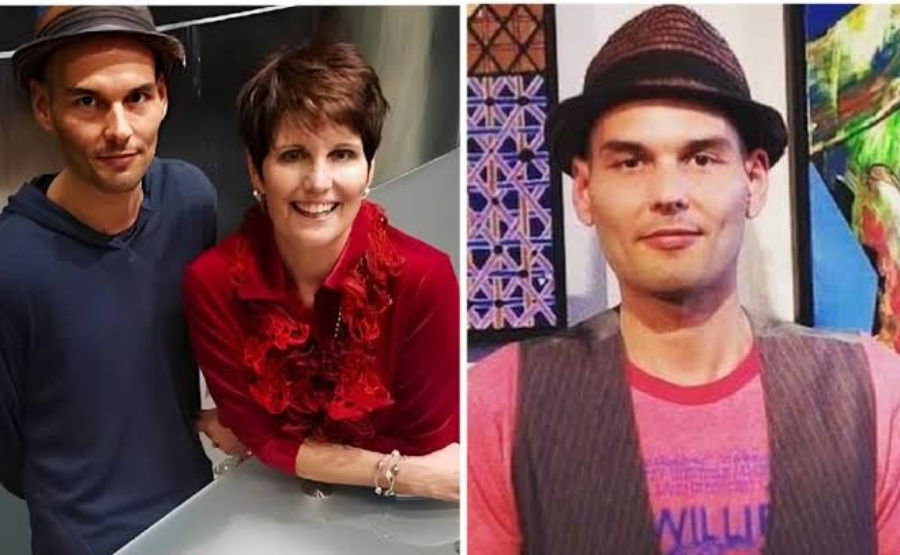
His work is described consistently as abstract and expressive, using color and emotion, storytelling through visual language. This is not particularly precise as an artistic description — these phrases apply to roughly half of living painters — but the lack of detailed public documentation about his specific style is itself telling. He hasn’t done press. He doesn’t have a prominent gallery presence that generates coverage. He is a painter who paints, apparently, without the machinery of celebrity biography surrounding the enterprise.
The Birth Order Question Nobody Resolves
Here’s a small but interesting discrepancy in the public record that most articles about Simon Luckinbill glide right past.
Some sources — including newswiki.it.com and boostix.it.com — describe him as “the oldest son” of Lucie Arnaz and Laurence Luckinbill. Others, including key.meshplusplus.com, describe him as “the second son.” This discrepancy matters because if Joseph Luckinbill was born before Simon, he is not the eldest child.
Looking at the marriage timeline: Lucie Arnaz and Laurence Luckinbill married in June 1980. Simon was born December 1980. This timing is tight enough that some sources place Simon as the first child, born in the first year of the marriage. If Joseph is the older sibling, he would have been born before the marriage or in the same tight window.
There isn’t enough public documentation to definitively resolve this. I’m noting it because it’s one of the places where the “oldest son / firstborn” framing that most articles use might be inaccurate — and it matters as a biographical detail because birth order shapes identity, particularly in families with professional legacies.
The Grandparents He Barely Knew
Both Desi Arnaz and Lucille Ball died before Simon was ten years old. Desi in 1986 (Simon was five), Lucille in 1989 (Simon was eight).
That age range — five to eight — is not nothing. Children form memories at this point. He would have known his grandparents as people who were in his life before they became the people who stare down from Hollywood walk-of-fame plaques. But he would not have known them as working professionals, not as the specific forces of cultural nature they became as posthumous icons.
This matters because it means Simon Luckinbill’s relationship to the Ball-Arnaz legacy is fundamentally mediated — through his mother, through the documentary and preservation work she did, through the culture’s ongoing processing of that legacy. He wasn’t shaped by Lucille Ball the working performer. He was shaped by Lucille Ball the icon, as interpreted through his mother’s relationship to that iconhood.
That’s a very specific form of inheritance. And it’s a different thing from, say, being the child of Desi Arnaz Jr. — Simon’s uncle — who actually shared time with his famous parents as adults.
The Father Who Wrote About Presidents
Laurence Luckinbill deserves more than a footnote here because he represents the other half of Simon’s formation — the half that wasn’t defined by I Love Lucy at all.
He was born in Fort Smith, Arkansas, the son of an oil worker. He came to acting through training, through work, through decades of professional craft. He wrote a one-man show about Lyndon Johnson that he performed and filmed. He appeared in Star Trek V: The Final Frontier as Sybok, Spock’s half-brother. He had a substantial stage career. He came to his marriage with Lucie Arnaz with his own professional identity intact.
One thing worth noting: Laurence was previously married to actress Robin Strasser. His sons Nicholas and Ben Luckinbill are from that marriage, making them Simon’s half-siblings. This blended family structure is sometimes confused in coverage, with some sites listing all four Luckinbill siblings as though they’re all children of Lucie and Laurence.
The Simon who emerged from this household had a playwright-director father who thought carefully about historical figures, and an actress-singer mother who was living inside a generational legacy in real time. The painter’s sensibility — the preference for image over word, for visual over performed — is not arbitrary given those inputs.
What The Internet Can’t Find About Him
Simon Luckinbill is not on social media in any verified way. He does not appear to have a gallery website that generates press coverage. He does not give interviews. He is not on the red carpet circuit. He appeared at some family events, presumably, but nothing that generated a Getty Images archive of his face.
This is unusual in 2025 for anyone, let alone someone with his family connections. The absence of a public profile is a choice so sustained it functions as a philosophy.
Here’s what the content farms have done in the absence of real information: filled it with the same templates that have appeared throughout this series. Some describe him as a “rising star” on some unspecified trajectory. One site describes his paintings as winning “numerous awards” without naming a single one. Another describes his artistic philosophy in terms so generic they could apply to any living visual artist. Several sites list net worth figures between one and four million dollars with no visible sourcing whatsoever.
The one thing most reliable sites agree on: he is a painter. He chose a creative medium entirely different from his parents’ and grandparents’. He maintains his privacy. As of late 2025, that remains his public identity.
The Broader Family Arc
You cannot write about Simon Luckinbill without thinking about the specific generational shape of this family.
Lucille Ball and Desi Arnaz: the foundational generation. Luminous, cultural, enormous. They built Desilu from scratch and produced some of the most significant television of the twentieth century. Their names are on the Hollywood Walk of Fame. Their show is still syndicated.
Lucie Arnaz and Desi Arnaz Jr.: the second generation. Both are talented. Both working. Both perpetually processing what it meant to be the children of icons. Lucie’s career was substantial on its own terms. Desi Jr.’s career had different arcs. Both navigated the specific challenge of being second.
Simon Luckinbill and his siblings: the third generation. The ones who grew up after the icons were already dead. The ones who came to consciousness in a world where Lucille Ball’s face was on posters and merchandise, where the footage played constantly, where the legacy was already cultural rather than personal.
And Simon’s response to all of that is: paint. Make visual art. Work in a medium that neither his grandmother nor his mother nor his father occupied. Build a practice that doesn’t get reviewed in the context of I Love Lucy reruns.
That choice is specific to someone who understood exactly what he was doing.
Final Words
Simon Luckinbill made the clearest possible statement about identity: he found something to do that couldn’t be compared to what his family did. He works in a medium where the Ball-Arnaz legacy is irrelevant as a measuring stick.
I can’t tell you whether his paintings are good—whether they are truly fascinating pieces of art or the dilettante work of someone with a well-known name who doesn’t need to sell paintings to make ends meet—because they aren’t accessible for public evaluation. He hasn’t made it available. That’s part of the point.
What I can tell you is that the specific choice to withdraw from the gravity of one of the most famous names in American entertainment, to find a medium where your grandmother can’t be measured against your grandmother, is a psychologically coherent and interesting response to being born where he was born.
He didn’t become an actor. He didn’t become a singer. He didn’t use the family name to his advantage as a television personality. He paints. He keeps quiet. And the internet, which cannot process either of these things gracefully, has responded by inventing an entirely fictitious public career for him.
The real story is simpler and more interesting. A man chose paint over the spotlight. Given the specific spotlight he could have chosen, that’s worth thinking about.
FAQs
1. Who is Simon Luckinbill?
Born in Los Angeles on December 10, 1980, he is the son of actor-playwright Laurence Luckinbill and singer and actress Lucie Arnaz. He is the grandchild of Desi Arnaz and Lucille Ball via his mother. He is a visual artist and painter who maintains a private life.
2. Is Simon Luckinbill Lucille Ball’s grandson?
Yes. Lucie Arnaz is Lucille Ball’s daughter, and Simon is Lucie’s son. He is Lucy’s maternal grandson. He was born in 1980 — his grandmother died in 1989, so he knew her briefly as a child before she became exclusively a posthumous icon.
3. What is Simon Luckinbill’s occupation?
He is a visual artist — specifically a painter. Multiple reliable sources confirm this. He works in an abstract and expressive style described as storytelling through color and emotion. He does not appear to have pursued acting or performing despite his family background.
4. Who are Simon Luckinbill’s siblings?
Joseph and Katharine Luckinbill, who are also the offspring of Lucie Arnaz and Laurence Luckinbill, are his full siblings. Nicholas and Ben Luckinbill are his half-siblings from his father’s first marriage to actress Robin Strasser.
5. Is Simon Luckinbill the oldest or second-oldest child of Lucie Arnaz?
Sources conflict on this. Some call him “the oldest son” and some “the second son.” His parents married in June 1980 and he was born in December 1980, so the question of whether Joseph preceded him is not cleanly resolved in the public record.
6. Who is Laurence Luckinbill?
Simon’s father. He is an American actor, playwright, and director born November 21, 1934, in Fort Smith, Arkansas. He is known for stage work, including a one-man show about Lyndon Johnson, and film appearances including Star Trek V: The Final Frontier. In June 1980, he wed Lucie Arnaz.
7. Is Simon Luckinbill on social media?
No verified accounts. Multiple sources confirm he maintains no public social media presence. He is described consistently as private and absent from public digital platforms.
8. What is Simon Luckinbill’s net worth?
Estimated between $1 million and $4 million across various celebrity net worth sites, without documented sourcing. His true financial status is not made public.
9. Did Simon Luckinbill ever pursue acting like his family?
Not to any documented degree. He became a visual artist rather than a performer. Some sites ask or speculate whether he went into acting because of his grandfather’s fame; the answer appears to be no.
10. How is Simon Luckinbill related to Desi Arnaz Jr.?
Desi Arnaz Jr. is Lucie Arnaz’s younger brother — making him Simon’s uncle. Simon and his siblings are Desi Arnaz Jr.’s nieces and nephews.
11. Where does Simon Luckinbill live?
Not publicly documented. He was born in Los Angeles and his family connections are rooted in the Los Angeles area, but his current residence is not confirmed in any reliable public source.
Beyond the headlines, discover what’s worth knowing — TheTrendist.