
Tim Tebow Net Worth Is Both Simpler and Weirder Than Anyone Admits
Stop me if you’ve heard this one: the faith-driven athlete who “couldn’t make it” in the NFL somehow built a financial empire anyway. The rags-to-riches-by-way-of-Jesus narrative. Inspiration porn dressed in athletic gear.
Here’s what’s actually true, and it’s stranger than any of those clean versions: Tim Tebow earned less from professional football than a mid-level regional manager earns over a fifteen-year career. The figure is documented, public, and almost nobody quotes it correctly. And yet he is, by any reasonable accounting, quite comfortable — probably wealthy. The gap between what he made as an athlete and what he’s apparently worth today is where the interesting story lives.
Let’s get into it.
Quick Bio
| Info | Detail |
| Full Name | Timothy Richard Tebow |
| Born | August 14, 1987, Manila, Philippines (missionary family) |
| NFL Career Earnings | $9,595,000 — documented, per Over The Cap contract database |
| NFL Teams | Broncos (2010–11), Jets (2012), Patriots (2013), Eagles (2015), Jaguars (2021, cut pre-season) |
| Estimated Net Worth (2025) | Ranges wildly: 5M–60M depending on the source. Most credible range: ~$10–20M |
| ESPN/SEC Network | Analyst since 2014; signed multi-year extension July 2026 |
| Primary verified income streams | Broadcasting, book sales, speaking fees, endorsements (Nike, Jockey, EA Sports, FRS) |
| Foundation | Tim Tebow Foundation — $43.1M revenue in FY2024; Tebow takes zero personal salary |
| Night to Shine (2024) | 720 churches, 56 countries, 100,000+ guests — he draws no compensation |
| Books | Shaken (2016): #4 WSJ nonfiction; Through My Eyes (2011): #1 NYT, 220,000+ copies |
| Wife | Demi-Leigh Nel-Peters, Miss Universe 2017; married January 2020 |
The Number Everyone Gets Wrong
Here’s where I want to start, because the net worth discourse around Tebow is genuinely one of the messier corners of the sports celebrity internet.
Per Over The Cap — which tracks every NFL contract with actual signed terms — Tim Tebow’s verified career earnings across all NFL stints total $9,595,000. That’s not an estimate. That’s what the contracts actually paid. His best single year was 2011 with the Broncos, when he pulled in about $4.2 million in cash. The Jets stint in 2012 added roughly $2.5 million. After that, the New England Patriots and Philadelphia Eagles deals were terminated before he saw a penny.
Think about that number — nine point six million dollars — and then look at the websites claiming his net worth is $40 to $60 million. You’ll find sites suggesting his net worth is anywhere from $5 million to $108 million. I’m not exaggerating that top figure. I found it. Someone posted it.
The spread from $5M to over $100M isn’t a disagreement over facts — it’s a sign that almost nothing about his post-football finances has ever been officially documented the way his NFL contracts were.
So let me work with what’s actually knowable.
See also “Lemuel Plummer Net Worth: How Much Is the Zeus Network Founder Worth?“
The Part Everyone Skips: He Was Never That Rich as an Athlete
Let’s be honest about the NFL career for a second. Because when people say “Tebow couldn’t make it in the NFL,” the implicit assumption is that he was this supremely compensated athlete who just couldn’t stay on a roster. That’s slightly off.
His rookie contract with the Denver Broncos was a five-year deal worth $11.25 million total, of which he actually earned $5.49 million before being traded. That’s a first-round pick deal — he went 25th overall in 2010, which is genuinely high. But because he was a first-round pick who flamed out relatively quickly as a starter, a large chunk of that contract was never fully paid.
The Jets acquired him in 2012. Gang Green reportedly agreed to pay him a $2.53 million salary advance as part of the trade parameters. He attempted eight passes for the entire season and was cut the following spring.
Then came the part of the career that earned zero coverage: the New England Patriots and Philadelphia Eagles deals were both terminated, and he earned exactly $0 from either.
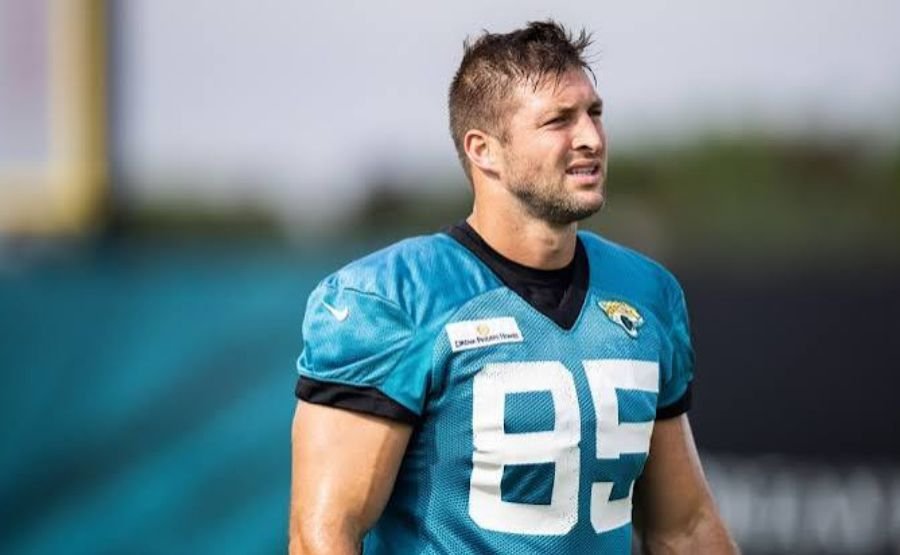
And then — and this is the detail that should make you pause — in 2021, at age 34, he signed a one-year $920,000 contract with the Jacksonville Jaguars as a tight end. A position he’d never played professionally. He was cut after one preseason game where his blocking ranged from awkward to awful. He didn’t make a single catch. The contract was voided. He earned nothing from it.
Why does this matter? Because the myth of the “extremely wealthy ex-NFL quarterback” assumes a level of athletic compensation that simply wasn’t there. He’s not Patrick Mahomes. He’s not even a middle-tier starter who hung around for eight seasons.
He made less from professional football than you might think. And he built whatever he has today from other places.
Where the Real Money Actually Came From
Okay. So if it wasn’t the NFL contracts, what is it?
Broadcasting is almost certainly the backbone of his current income. ESPN has kept Tebow as a college football analyst on SEC Nation since the network’s launch in 2014, and in July 2026 announced a multi-year contract extension. ESPN content president Burke Magnus praised Tebow’s experience and “genuine passion for the game,” calling him one of the sport’s most credible voices among SEC fans.
Nobody publishes what ESPN pays its analysts publicly. But context clues exist. One unverified site suggests around $5–7 million annually, which would be aggressive for a studio analyst who isn’t a flagship name like Kirk Herbstreit or Chris Fowler. A more realistic number is probably somewhere in the $1–3 million range annually for a traveling pregame show role. Still solid. And it’s been running for over a decade, so the cumulative number adds up.
The books are real money. Through My Eyes sold 220,000 print copies by late December 2011, making it HarperOne’s biggest book of that year. The best-selling sports book of 2011 by Nielsen BookScan, outselling ESPN’s own history book by 70,000 copies. Shaken in 2016 landed at number four on the Wall Street Journal nonfiction list and number 17 on USA Today’s broader bestseller chart. He’s published several more since then. These aren’t vanity projects — they move units, especially in faith-based markets where bulk institutional purchases by churches inflate the numbers beyond what BookScan captures.
Endorsements. Nike signed him in April 2010 for just under $300,000 a year at minimum with upside incentives. Jockey followed with a multi-year deal in July 2010, where Tebow became the face of their Staycool collection. EA Sports had him on NCAA Football covers. He also had FRS Healthy Energy and Palm Beach Autographs. At peak Broncos-mania in 2011, he could command about $500,000 annually from sponsorship deals alone. Those specific deals have almost certainly not all survived to 2026, but the brand has — and brands find ways to stay monetized.
Public speaking. Nobody talks about this one. Tebow operates on the Christian conference circuit, which is massive and largely invisible to mainstream sports media. Major faith-based conferences pay five figures per appearance easily for names of his caliber. He’s done this for years.
Real estate. Florida properties, reportedly in Ponte Vedra Beach and the Jacksonville area. We don’t have hard numbers. Multiple sources mention it. Take it for what it’s worth.
The Foundation Is Not His Personal ATM (And That’s Worth Noting)
This is genuinely the thing about Tebow that I think gets either ignored or weaponized depending on who’s writing.
According to ProPublica’s analysis of the Tim Tebow Foundation’s Form 990 filings, Timothy R. Tebow is listed as Chairman and receives exactly $0 in compensation. Zero. Not a reduced salary. Not a symbolic dollar. Nothing.
The foundation had revenue of about $10.3 million in 2020, which spiked to $40.1 million in 2021, then dropped to $21.9 million in 2022. Those are big swings. MinistryWatch noted that the foundation’s Financial Efficiency rating fell from 3 stars to 2 stars, with the net asset utilization earning just 1 star, as the foundation was sitting on $44.5 million in net assets as of 2022.
So there’s a legitimate watchdog question there — why does a foundation holding $44 million spend several years not deploying those assets at the rate you’d expect? That’s worth asking. But it’s separate from the personal net worth question, and worth being precise about which is which.
Early reports confirmed that Tebow pays all foundation staff and administrative costs himself, so that all donations go directly to outreach efforts. If that’s still true in 2026 — and nothing I found contradicts it — then the foundation is actually costing him money, not generating it.
Night to Shine, the foundation’s signature event, has grown into something genuinely staggering. In 2024, 720 churches across 56 countries and all 50 US states hosted simultaneous prom nights for people with special needs, welcoming over 100,000 guests. It started with 44 churches in 2015. Early events reached 75,000 attendees across 375 churches and 11 countries.
That’s not a vanity project. That’s an institution. Whether you agree with the faith-based framing or not, the operational scale is real.
The 2021 Jaguars Stunt and Why It Matters Financially
The Jaguars comeback is usually covered as either inspirational or embarrassing, depending on your priors about Tebow. I want to look at it through a different lens.
In early 2021, Tebow retired from baseball — citing feeling “called in other directions” — and then almost immediately signed with the Jacksonville Jaguars to attempt an NFL return as a tight end under his college coach Urban Meyer.
He was 34 years old. He had never played tight end in his professional career. It was obvious after one preseason game that he couldn’t keep up even against second- and third-string opponents. Meyer himself said Tebow’s blocking was inconsistent, and he played no special teams snaps — which at tight end is often what earns a roster spot for a veteran without elite physical skills.
An ESPN analyst said it plainly: Tebow was “a polarizing former athlete that we can’t stop talking about” — and noted the criticism that he’d been given opportunities others with his credentials wouldn’t have received.
That’s fair. Let’s hold it.
Urban Meyer’s link is not coincidental. Meyer was Tebow’s coach at Florida for two national championships. This was a loyalty signing with a side of spectacle. It didn’t cost Tebow anything financially since the contract was voided when he was waived. But it did reinforce — for the tenth time — that the Tebow conversation never fully leaves the sports news cycle.
And sustained conversation is its own kind of economic asset.

The Range Issue: Why No One Can Provide a Clear Solution
You deserve a number. Here’s the most honest one I can construct:
Verified NFL earnings: ~$9.6 million. Take-home after taxes and agent fees: probably somewhere around $5–5.5 million.
A decade-plus at ESPN on what is credibly a multi-million dollar annual deal. If he averaged even $1.5 million a year since 2014, that’s $18 million in broadcasting alone before the 2026 extension.
Two New York Times bestselling books with combined 300,000+ copies sold at retail, plus back-catalog sales, youth editions, and an audiobook market that didn’t exist in 2011. Probably $3–5 million in total book income over time, conservatively.
Endorsements from 2010–2016 at a publicly confirmed $500K+ annual floor, possibly higher during peak Tebowmania. Call it $4–5 million total across that period.
Speaking engagements on the Christian conference circuit for fifteen years. These aren’t free appearances. Probably $2–4 million across the period.
Real estate in one of Florida’s more desirable coastal markets.
Add it up and the realistic floor is probably somewhere around $15–20 million in accumulated wealth. Not $50 million. Not $108 million. But not $5 million either.
The chaos in the estimates is because almost none of the post-football income is publicly documented. He doesn’t have to file income disclosures. His ESPN contract terms are private. His speaking fees aren’t disclosed. His book advances from HarperCollins and Penguin Random House aren’t public. So people just… make numbers up, ranging from wildly conservative to absurdly inflated.
And weirdly, Tebow doesn’t seem to care. He’s never done a Forbes piece on his finances. He’s never sat down for a “how I built my brand” interview with a business publication. Which is either principled restraint or very good PR. Possibly both.
Final Words
Tim Tebow’s financial story is less about football money and more about understanding that a certain kind of American cultural celebrity — faith-forward, persistently likable, controversy-adjacent without ever being actually scandalous — can be monetized in ways that don’t show up in conventional athlete wealth narratives.
He made about ten million dollars as a football player. That’s it. The rest is brand, book, broadcast, and belief.
There’s something worth being honest about here: Tebow has operated in a faith-based market where his audience is intensely loyal and underserved by mainstream media. The same demographic that makes Christian book sales spike and fills conference centers and watches SEC Nation at 10am on Saturdays. He found a lane and he rode it for fifteen years.
Is the worship of him as a financial genius overdone? Yes. The people claiming he’s worth $60 million are working from thin air.
Is the dismissal of his post-football career as a failure equally misguided? Also yes.
He built a charitable operation running over $43 million in annual revenue that he doesn’t take a cent from. He built a broadcasting career that survived multiple ESPN rounds of cost-cutting and earned him a 2026 contract extension when the network was simultaneously laying off people mid-show. His books sold in numbers most authors, faith-based or otherwise, would give a kidney for.
The number isn’t $100 million. But it’s real. And it came from something that wasn’t athletic talent. It came from the fact that Tim Tebow found out, early, that who you are can be more durable than what you do.
That’s not nothing. Even if you find the whole thing deeply annoying.
See also “Mayweather Net Worth: The $1.2 Billion Fortune That May Not Exist Anymore“
FAQs
1. What is Tim Tebow’s net worth in 2025?
The honest answer is: nobody outside his accountant really knows. The verified floor is roughly $9.6 million in NFL earnings, plus broadcasting, book sales, endorsements, and speaking. A realistic estimate is $15–20 million. Anything above $30 million is speculation dressed up as research.
2. What was Tim Tebow’s NFL salary?
Exactly $9,595,000 in documented career earnings across the Broncos and Jets — with $0 earned from the Patriots, Eagles, and 2021 Jaguars contracts, all of which were terminated before he saw money.
3. Does Tim Tebow make money from his foundation?
No. He receives zero salary from the Tim Tebow Foundation. He’s listed as Chairman on the Form 990 with $0 in compensation, and early accounts confirm he paid administrative costs himself so donations went directly to programming.
4. How much does Tim Tebow make at ESPN?
Not publicly disclosed. He’s been with SEC Network since its 2014 launch and just signed a new multi-year extension in 2026. Reasonable estimates for his role put it somewhere in the $1–3 million annual range, but that’s informed speculation, not a confirmed number.
5. What happened at the Jacksonville Jaguars?
He signed in May 2021 to attempt a comeback as a tight end under his former college coach Urban Meyer, was cut after one preseason game where his blocking was called inconsistent and he failed to record a catch or play any special teams snaps. The contract paid him nothing.
6. Why do net worth estimates for Tebow vary so wildly?
Because his post-NFL income — broadcasting, books, speaking, endorsements — is almost entirely undisclosed. Sports contract databases cover NFL earnings precisely. Everything else is guesswork, and the internet has a long tradition of amplifying the most dramatic guess.
7. Did Tim Tebow’s books actually make real money?
Yes. Through My Eyes sold over 220,000 copies in 2011 alone, making it the best-selling sports book of the year. Shaken hit the Wall Street Journal’s nonfiction top 5 in 2016. He has multiple titles. Book advances at his sales level, plus royalties, add up to meaningful money — probably several million across his publishing career.
8. What endorsements has Tim Tebow had?
Nike (signed 2010, under $300K annually at minimum), Jockey (multi-year deal from 2010, became face of their Staycool line), EA Sports, FRS Healthy Energy, and Palm Beach Autographs. Most of these peak-era deals aren’t likely still active at original terms.
9. Does Tebow make money from Night to Shine?
No. Night to Shine is hosted by churches that largely self-fund through donations, with the Tebow Foundation providing guidelines and support. He attends events and provides organizational infrastructure. He takes nothing personally.
10. How does Tebow’s net worth compare to other Heisman winners?
Unfavorably by raw number, but that’s an unfair comparison because most Heisman winners had longer, more lucrative NFL careers. He’s almost certainly wealthier than the average Heisman winner who didn’t become a franchise QB — his post-football revenue streams are unusually diversified for someone who wasn’t an elite NFL starter.
11. Is Tim Tebow still making money in 2026?
Yes. ESPN announced a multi-year contract extension with Tebow in July 2026, keeping him as a college football analyst on SEC Nation and across College Football Playoff programming. He’s an active income-generating person, not someone coasting on old savings.
Beyond the headlines, discover what’s worth knowing — TheTrendist.






One Comment